


For those who are brand new to the Bible and the differences in the Christian sects, what follows is a brief overview of the history and development of the Bible over the last two millennia. This is not a thorough analysis of the thousands of years of arguments over Biblical canon — this is a simplified discussion of what is historically factual, mostly for those who are new to this discussion and have always wondered why different sects of Christianity have different numbers of books in their Bibles.
The Bible is a collection of writings created over many centuries, in many languages, rather than a single book written all at once. The Bible is divided into two main sections: the Old Testament, which is a collection of the sacred writings of the Jewish people and focuses on creation, God’s covenant with Israel, and the law and prophets; and the New Testament, which centers on the life and teachings of Jesus Christ and the early Christian church. The Old Testament was written in the years B.C. (Before Christ), and the New Testament was written in the years A.D. (Anno Domini — meaning in the year of our Lord, referring to the years after Jesus’ birth).
In early Christianity, there wasn’t a fixed number of books canonized as “the Bible” — there was a collection of 80+ books used by clergy and biblical scholars. They had various levels of importance and contain varying content — the law handed down from God to Moses, history, wisdom/poetry, prophets, gospel (the “good news” of Jesus Christ comprised in what are probably the four most famous books of the Bible: Matthew, Mark, Luke, and John), letters (epistles), and apocalyptic prophesy. There are dozens of other books written by Jewish and Christian scholars that are not considered biblical canon but are considered historically important to the body of the Christian Church.
The books of the Bible were written by about 40 different authors over about 1500 years in different historical and cultural settings and languages, including Hebrew, Greek, and Aramaic, and were later gathered, preserved, and translated as communities of faith recognized them as meaningful and authoritative for understanding God and living a faithful life. The Old Testament was originally written in Hebrew and was transcribed into Greek over the course of a few hundred years prior to Jesus’ birth. The Greek translation is called the Septuagint, and it contains 51 books. The New Testament was originally primarily written in Greek.
The various Christian denominations as we know them today — Catholic, Orthodox, Protestant — have their own slightly different versions of how many books they include as canonical in their bible, as shown in the infographic below.
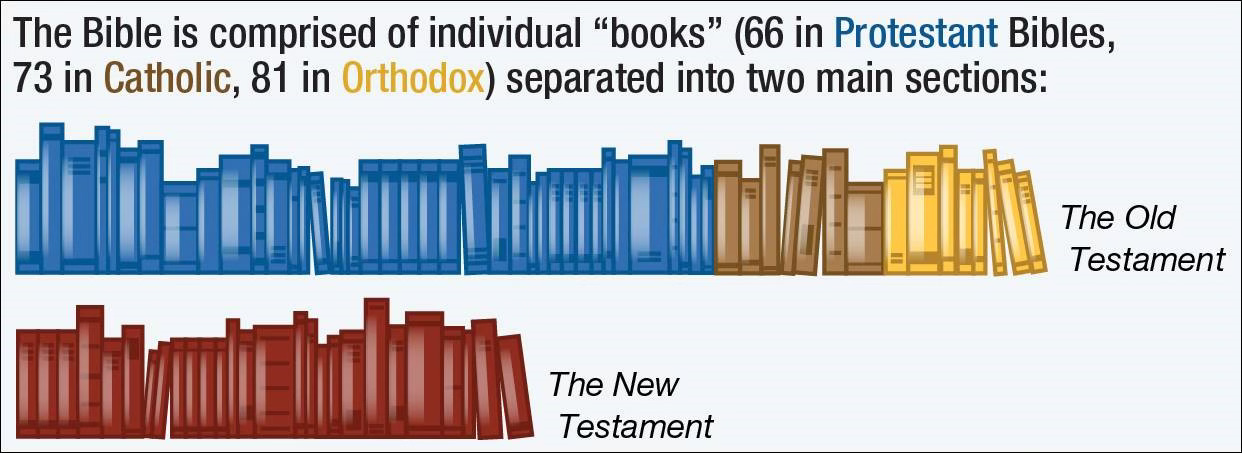
The Catholic and Orthodox churches trace their history back to Jesus. They developed from the same original unified Christian church — with Catholic meaning universal or according to the whole and Orthodox meaning right belief or correct teaching (and both words originating in Greek). The original Christian church emerged in a time when not everyone could read, and almost no one outside of clergy, churches, and monasteries had a Bible. Prior to the invention of the printing press, all copies of the Bible were transcribed by hand, and owning one outside of a church or monastery would have been extremely rare.
At this time, and for about 1500 years, the Christian religion flowed from the Church as the authority and keeper of the religious tradition, with the scriptures supporting those traditions and being accessible to, and read and taught by, the clergy. This is why various Orthodox churches have slightly different canons in their Bibles. While there have, at times, been movements to restrict who read the Bible for dubious reasons, the lack of laypeople reading the Bible for themselves typically wasn’t a conspiracy — it was simply the nature of the historical reality of literacy rates and the accessibility and significant cost of books. The unified church was the main keeper of tradition.
So then, brothers and sisters, stand firm and hold fast to the teachings we passed on to you, whether by word of mouth or by letter.
2 Thessalonians 2:15
The biblical canon of the unified Christian Church took shape over the first several centuries of Christianity. The Council of Rome in 382 AD affirmed the 46 books of the Old Testament and 27 books in the New Testament that comprise the Catholic canon today. Nevertheless, full consensus across all Christian communities developed gradually and independently, and clergy continued to read and engage with a variety of non-canonical texts that were not necessarily considered Scripture, but were considered historically important.
Growing tensions between the Eastern and Western Christian traditions resulted in the Great Schism in 1054 A.D., wherein the Catholic Church and the Eastern Orthodox Church split into two Christian traditions separate from one another. The Catholic Church has kept the canon of the 73 books established in the 4th century (and by this time was using a Latin translation), while the Orthodox Church included more of the books preserved in the Septuagint. Different Orthodox churches have slightly different canon ranging from 76 for Greek Orthodox to up to 88 for Ethiopian Orthodox, and other variations in between.
The Protestant Reformation arose in the 16th century, approximately 500 years ago, over disagreements with the Roman Catholic Church. The invention of the printing press amplified these critiques, allowing ideas about reform and direct access to the Bible to spread rapidly across Europe.
Arguments about which books to include in the Protestant Bible arose, with Reformers desiring to remove books that they disagreed with theologically. They pulled 7 books out of the Old Testament, labelled them “apocrypha,” and moved them to the back of the Bible. The books they retained were consistent with the Masoretic Text, the Hebrew text of the Old Testament developed in the 7th-10th centuries — though it could be argued that this Jewish text had incentive to drop books and passages that, in retrospect, affirmed Jesus as the Messiah. Martin Luther, father of the Reformation, also wanted to remove 4 books from the New Testament (Hebrews, James, Jude, and Revelation), but this did not reach wide agreement and support. The Protestant Bible actually continued to include all 73 books, with the apocrypha printed at the back, until the 1880s, when they removed those 7 books altogether and started printing 66 book Bibles to cut costs.
Some Protestants argue that the Catholic Church added books to the Bible, but as you can see from the timeline and evolution of the canon of various Christian factions, this simply isn’t historically accurate. There have always been a lot of books with various levels of importance. It’s not like the Catholic and Orthodox Church went 1500 years without a set of books they called the Bible and then added to their theology later — they evolved independently and together with slightly differing canon depending on what was considered most crucial to their traditions. In the mid 16th-century, the Roman Catholic Church gathered in response to the Reformation and reaffirmed their 73 book Biblical canon (amongst other traditions).
The simple truth is that many of the theological aspects at the center of the Protestant Reformation were discussed and validated in the books that got cut, and these books are important to overall Christian history and theology — whether you personally consider them scripture or not, and whether they agree with your sect’s theology or not. I look forward to further discussing the arguments for and against these books as we get to them in the readings.
It also does not escape me that the Protestant Bible contains 66 books, but I digress.
The good news is that all the arguments are about how many books are included in the Old Testament. Everyone agrees that there are 27 books in the New Testament. Well, everyone except the Ethiopians.
Do you have questions or comments on the development of the Bible? Ask in the comments below! This topic can be divisive so I ask that everyone approach this topic with respect and curiosity.
Hi Adrian, thanks for putting together this piece to set the scene for your bible study group (which I’m excited about!). As a Baby Christian, there’s sooo much context I need to try to absorb and read/hear about several times over to even begin to feel I can start to understand God through his word. This brief history is really helpful for people like me! 🫶🏼
Thank you so much for doing this study and explaining so well. I grew up protestant and as an adult I have had so many questions, confusion and doubt about the Bible. So this is much needed for me. Will you explain what criteria the Catholic & Orthodox used to determine if a book was canonical or what that really means?