


The Book of Enoch has had a major resurgence in recent years.
A major influence on early Jewish and Christian cosmology, lost for thousands of years to everyone but the Ethiopians, rediscovered in the 18th century and disseminated widely in the 21st century in a culture growing more willing to pull back the veil to understand the spiritual implications of our world.
The Book of Enoch is at once a catalogue of offenses caused by fallen angels, a detailed instruction guide for using the stars as a clock, and an apocalyptic beacon that mirrors Revelation as a prologue bookending the Bible.
But upon reading Genesis, a question commonly arises: Whose book is this?
Enoch is the third generation of human—born to Cain, the grandson of Adam.
And Enoch is also the “seventh [generation] from Adam,” a descendant of Seth’s lineage who walked faithfully with God for 300 years— until one day he up and disappeared with Him.
This is the story of two Enochs—one born in exile East of Eden, the other exalted in communion with God. The repetition of this name, as well as other repetition in scripture, is an intentional theological contrast woven into the very origins of civilization.
In the beginning—before nations, before Moses and the Torah, before temples or kings—Scripture presents two competing visions of what it means to be human. One in accordance with God’s desires for us, and one in opposition to Him. These emulations of God’s design are embodied most clearly in two men named Enoch, each placed in the early generations of two diverging post-Eden genealogies.
Enoch begat Irad begat Mehujael begat Methusael begat Lamech — on Cain’s line.
And Enoch begat Methuselah begat Lamech — on Seth’s line.
Both of these lineages end at the flood — with the exception of Noah, son of the Sethite Lamech, great-grandson of the eponymous author of the Book of Enoch.
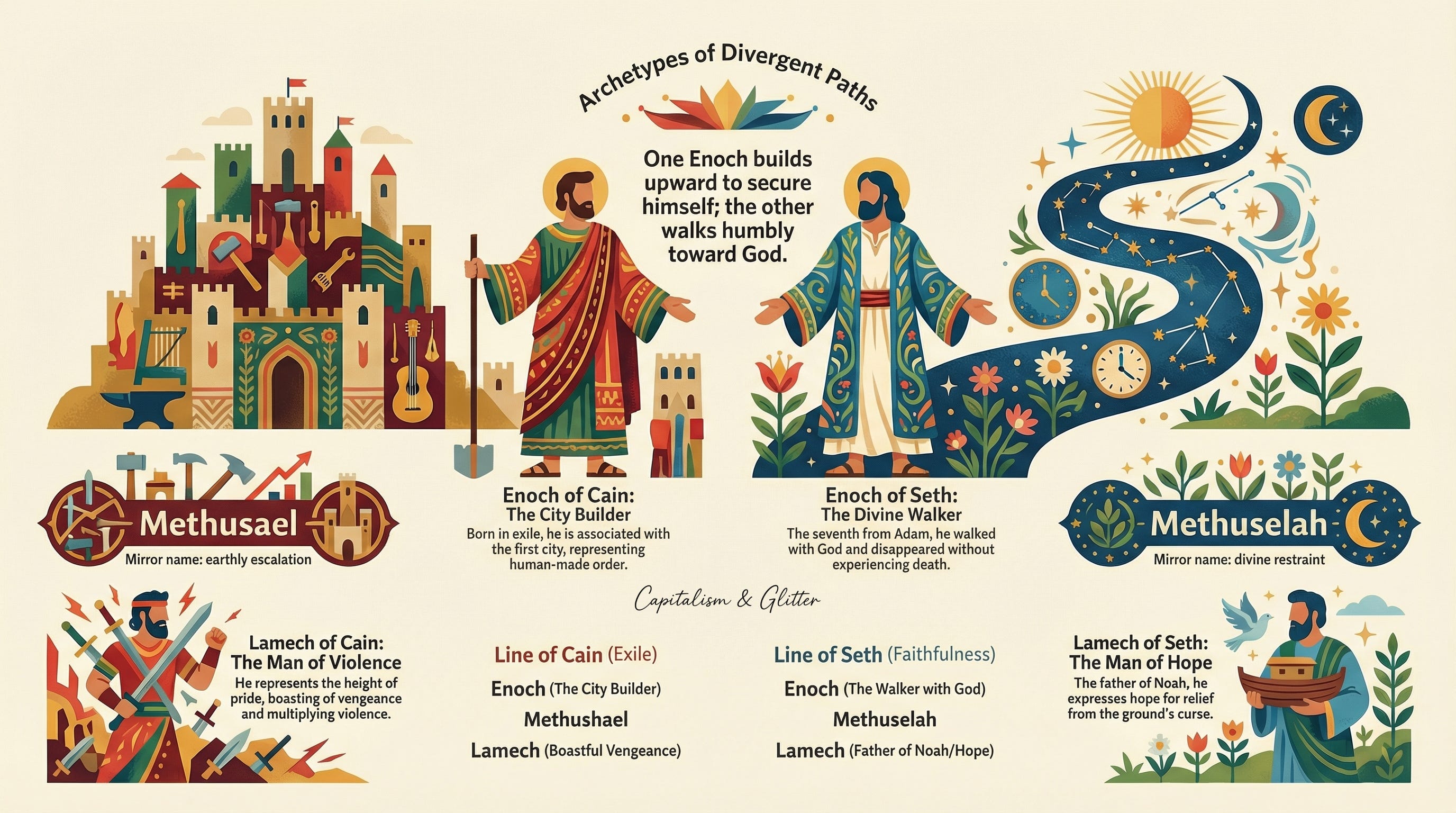
The two Enochs stand in stark contrast, illustrating opposing value sets and two very different paths in the origin story of humanity.
This article traces the two Enochs and the broader theological architecture constructed in Genesis in the narrative sequence between the Garden of Eden and the Tower of Babel.
Two roads diverge out of early humanity, and what emerges is a clear story about the origins of civilization, and the danger of building a world without God.