

Adam and Eve: The Genesis of Genetics
What the Human Genome Actually Says About Our Origins


Every single human being alive on Earth today can trace their maternal lineage through an unbroken chain of mothers back to one woman.
One.
Her mitochondrial DNA (the genetic material that lives outside the cell nucleus and passes only from mother to child) survived in an unbroken chain to you, to me, to all eight billion of us.
On the paternal side, the story mirrors itself.
One man is the common ancestor of every living man’s Y chromosome, passed down from father to son for millennia.
“Mitochondrial Eve” and “Y-chromosomal Adam”
The story according to mainstream science is that Mitochondrial Eve lived somewhere in sub-Saharan Africa, roughly 150,000 to 200,000 years ago. She wasn’t the only woman alive. She wasn’t alone in a garden. They are very careful to say that. But she is the most recent common ancestor of every human maternal line, meaning every other woman’s matrilineal lineage eventually died out, and hers didn’t.
Y-chromosomal Adam is estimated to have lived somewhere between 200,000 and 340,000 years ago. Not at the same time as Mitochondrial Eve, but likely in the exact same region of Africa.
These dates are calculated using something called the molecular clock, which is an assumed mutation rate that tells researchers how far back a lineage branches. Under the standard model, these two figures represent not a literal Adam and Eve who existed as a couple and populated the world, but as the oldest known genetic roots of the entire human family tree.
The Clock We Built Ourselves
But the molecular clock has a major problem. The dates given for Mitochondrial Eve and Y-chromosomal Adam are not measured, they are calculated using an assumed mutation rate. Change the assumption, and the dates move. Dramatically, in some cases. But that’s not even the biggest issue.
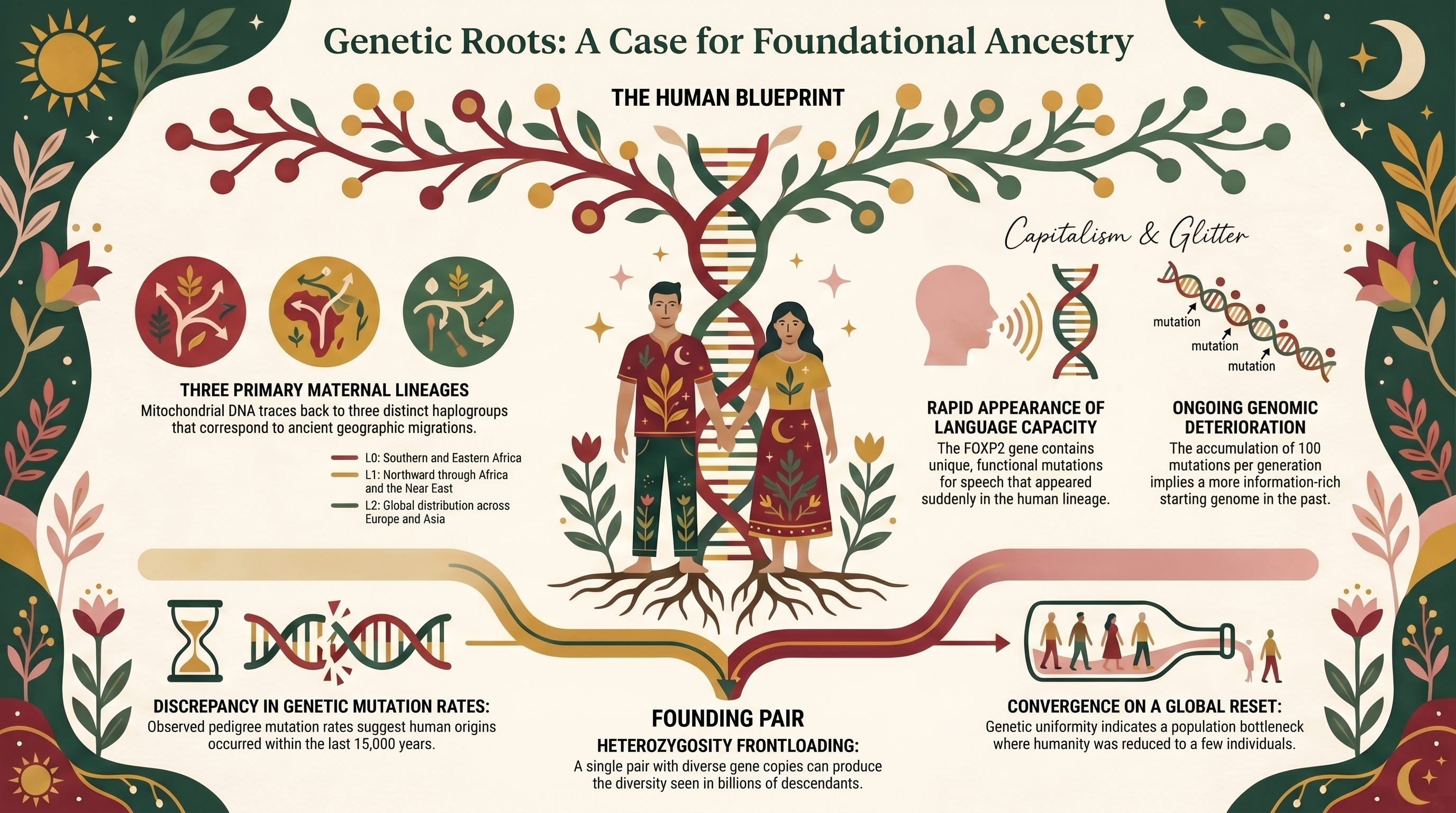
There are two clocks, and they disagree by a degree of 2x.
The pedigree rate is the mutation rate actually observed in living parents and children across multiple generations. It runs roughly twice as fast as the phylogenetic rate which is used to calibrate deep-time dates. Scientists calibrate the slower phylogenetic clock against fossil dates. But fossil dates are themselves derived from radiometric methods with their own potentially faulty assumptions.
The entire system is self-reinforcing: fossils date the molecular clock; the molecular clock dates the fossils. A skeptic is entirely justified in asking whether this house of mirrors could be systematically off.
And if you plug the faster pedigree rate into the genetic models, Mitochondrial Eve’s date compresses dramatically, potentially to within the range of recorded human history. The genetic “Adam” and “Eve” could both fall within 5,000–15,000 years ago, not hundreds of thousands.
This aligns with the biblical timeline, and also puts both “Mitochondrial Eve” and “Y-chromosomal Adam” into the same general time frame — in the same general location.
Capitalism & Glitter is a reader-supported publication.
If you’d like to support us and receive scientific deep dives like this one directly in your inbox, please consider a paid subscription. Paid subscribers receive:
The Edit newsletter, and access to all community chats
Full-length weekly Biblical, cultural, and archaeological deep dives
The entire archive of content on health and wellness, secret societies, and more (75+ articles)
Discounts on merch and upcoming ebooks
The Genetics of the Great Flood
Both “Mitochondrial Eve” and “Y-chromosomal Adam” each have 3 distinct subgroups. That means that genetically, everyone comes from 3 male lines, and 3 female lines, a split which appears a bit later on in the genetic lineage.