

Homeschool 101
Our homeschool journey thus far, and my thoughts on the popular methods

“I could never homeschool.”
I’m at the park, and I overhear two moms talking about what they’re going to do about our town’s less than stellar public school options.
“I mean, my husband and I are more than qualified,” she continues. “We both have masters degrees in engineering.”
As if a higher education degree in a specialized field is what qualifies one to homeschool their children.
In mainstream circles (especially those that are more progressive or liberal), homeschooling is often spoken of with derision and skepticism. There is a persistent belief that homeschooling lacks academic rigor, and that without certified teachers, standardized curricula, and institutional oversight, children simply “don’t learn enough” — despite a plethora of research indicating that homeschooled children frequently perform better academically and socially than their public school peers.
Many critics argue that homeschooling should be more tightly regulated or even outlawed, with some even assuming that families who educate their children at home are hiding something, such as neglect or abuse. These concerns are often amplified by anecdotal cases that receive disproportionate attention from the media, creating a narrative where homeschooling is seen not just as an alternative path to public education but as a potential sinister risk to a child’s development and well-being.
Why Do People Homeschool?
Before 2020, the classic homeschooled child stereotype was that of a white, conservative Christian, living in a rural area with a large family, where one parent (usually the mother) stays home to teach children who are isolated and socially awkward.
But the pandemic blew that stereotype out of the water.
Suddenly, everyone was homeschooling, whether they wanted to or not. Left or right, Christian or atheist, rural or urban — with in-person instruction shut down across the country, and online instruction taking its place, millions of American parents suddenly found themselves educating their children at home.
And, when schools opened back up, many families found they had adapted to and preferred homeschooling to sending their kids away each day. Some of the reasons homeschooling continues to grow in popularity include safety concerns (bullying, school shootings), academic concerns, disagreement with school policies (pandemic response, medical requirements, etc), and simply wanting to be with their children more during a period of family life that is ever-fleeting.
Homeschooling today spans a wide spectrum of approaches: from highly structured, academically rigorous programs to more flexible, child-led learning environments, to fully loosey goosey situations lacking any structure at all. Reducing it to either neglect or indoctrination misses the diversity of families and motivations involved, and overlooks the growing body of evidence that, when done thoughtfully, homeschooling can produce well-educated, socially capable, and independent thinkers — with a much higher success rate than the public school system.
Dumbing Us Down
I would be remiss if I didn’t mention social media’s contribution to the shift in the perception and increasing rate of homeschooling.
With everyone locked down and glued to their phones, anyone questioning anything was served a plethora of content questioning the status quo.
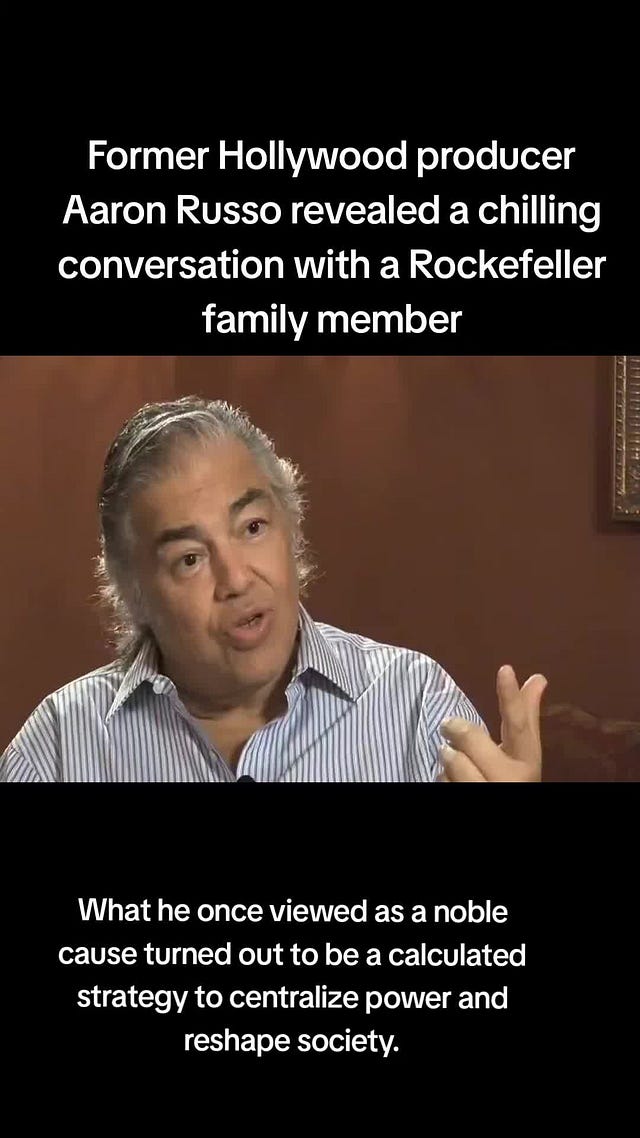
There is one particularly interesting viral clip of Aaron Russo detailing a member of the Rockefeller family telling him that the women’s liberation movement was funded by the ruling class to tax the other half of the population, destroy the nuclear family, and indoctrinate children, with the government taking the place of the trusted parent:
 Tiktok failed to load.
Enable 3rd party cookies or use another browser
And then there’s Dumbing Us Down, a book by former teacher John Gatto that has become increasingly popular in libertarian, conspiracy, and anti-government circles, especially those that trend towards homeschooling. Gatto argues that the public school system does not truly educate students, but intentionally produces passive, dependent, and conformist individuals rather than independent thinkers.
Gatto explains that public school confuses the students by presenting an incoherent ensemble of information to be memorized, teaches them to accept their class affiliation, and makes them indifferent, emotionally and intellectually dependent. Compulsory schooling, he argues, instills in children a kind of self-confidence that requires constant confirmation by experts — and makes it clear that they cannot hide, because they are always supervised.
Gatto’s book was published in 1992, but it wasn’t the first book to criticize the modern institution of American education. Back in 1901, Edward Ross, a sociologist and journalist identified education as a specialized institution for maintaining social order, increasingly replacing the family and church in modern society.
And in 1923, Upton Sinclair wrote The Goose Step: A Study of American Education arguing that higher education is controlled by wealthy capitalists and serves as a tool for propaganda rather than genuine intellectual growth. Sinclair used the "goose-step" metaphor to describe the blind obedience and militaristic values he saw in the system, influenced by the post-WWI era. Obviously, a book entitled The Goose Step fell out of common discussion after 1945.
Criticism of education is a place where the far right and far left leaning communities meet, with even the more moderate left-leaning groups acknowledging the school-to-prison pipeline — the modern trend of at-risk, impoverished, and particularly black and brown youth being funneled out of public schools and into the juvenile and criminal legal systems, reflecting a system that prioritizes incarceration over education.
It’s no wonder that homeschooling rates in America have doubled since 2020, with families of all walks of life turning to schooling their children at home.
What Exactly Is Homeschooling?
“Homeschooling” is not just one method of educating children: it is an umbrella term that covers all approaches to educating children outside of the traditional public or private institution settings. Most parents/guardians are their child’s main teachers, most families follow one or a few styles, and some methods are more popular than others.
Some of the most common approaches to homeschooling include:
Traditional — “School-at-home” closest to a typical regular classroom, with a structured schedule, textbooks, tests, grades, and often using full curriculum packages
Classical — Based on the trivium (grammar, rhetoric, and logic) education system rooted in ancient Greece and Rome; heavy focus on language, history, philosophy with memorization early on, critical thinking later; includes Latin
Unschooling — The least structured approach, with no formal curriculum or schedule, where learning follows the child’s interests
Unit Studies — Immersive, project-based learning that revolves around one theme at a time and integrates multiple subjects into one topic
Eclectic — The most common approach today wherein parents mix different methods depending on what works best for each child (e.g., math curriculum + unschooling for art + classical reading)
And then there are the schooling methods that grew from one figurehead, including:
Charlotte Mason — Focus is on “living books” (engaging with quality literature rather than textbooks), nature study, journaling, art, and music
Waldorf — Developed by Rudolph Steiner, emphasizes imagination, rhythm, and holistic development through art, storytelling, and experiential learning
Montessori — Developed by Maria Montessori, a child-led hands-on learning approach focused on practical skills and independence
And outside of the home learning opportunities including:
Online/Virtual — Can be self-paced or led by a teacher, includes video lessons
Hybrid/Co-Op — Kids attend classes part-time (co-ops, micro-schools), parents share teaching responsibilities with other families
Most families don’t stick strictly to one method. Over time, they tend to blend styles based on what actually works for their child. A rigid commitment to a single philosophy can backfire if the child’s learning style doesn’t match it.
And a word of warning:
Anything can become a cult if you want it to be.
Critics sometimes associate homeschooling with cult-like behavior.
And in some cases, they aren’t wrong.
Any belief system can take on the characteristics of a “cult” depending on the adherents behavior. Humans by nature are designed to worship, and often misplace said worship. Humans are prone to becoming rigidly attached to various ideologies, defending it at all costs and filtering out anything that challenges it.
Education is no exception.
I would argue that the cult of public school is the worst offender. There exists a cultural orthodoxy that permeates mainstream society perpetuating the belief that public school isn’t just an option, it’s a civic obligation. Even if the school district you reside within is bad, your kids must attend, and their education must be sacrificed for the greater good: to keep schools funded. The individual child’s experience is secondary to the long-term financial solvency of the institution. This, despite all evidence that American schools are getting markedly worse by all measures decade after decade.
And then there are the various homeschool cults.
The unschoolers who are lazy and don’t actually teach their kids anything.
The Charlotte Mason moms who treat her writings less like guidance and more like scripture.
The Waldorf moms who wont let their kid play with legos for fear of disrupting their “etheric body.” (The lowest layer of the human body/energy field — it’s an occult thing, look it up.)
And then of course there are the families who are in actual religious cults featured in Netflix documentaries.
If you are a parent researching various options and approaches to education, you are bound to stumble across some or all of these in your research.
What emerges on both sides is the same underlying pattern: a tendency to turn educational choices into moral positions. Public school becomes a duty. Homeschooling likewise becomes a social statement. And within homeschooling, specific methods can become markers of identity.
But children are not ideologies to be proven. They’re individuals, and they need (and deserve) an education. The moment any approach becomes more about defending the system than serving the child (a tendency I’ve witnessed from homeschooling groups to my DMs), it risks becoming the very thing it set out to protect against.
Read on for my detailed thoughts on the various approaches to homeschooling, and what has and hasn’t worked for my family — including my review of The Good and the Beautiful, a very popular curriculum with influencers.