

Hydroxyapatite: The Good, The Bad, and the Ugly
Why my family stopped using hydroxyapatite toothpaste (and no, we don't use fluoride either)



Disclosure: This article is sponsored by ZEBRA. The viewpoints and ingredient assessments presented here are our own and are informed by independent research into oral health, environmental exposure, and long-term prevention. We only partner with brands whose formulations align with our standards for ingredient integrity and non-toxic design. If you’d like to support us, you can shop ZEBRA and use code GLITTER for 10% off.
My Story
Like many people who stumbled into the holistic world during a major health crisis, I very quickly realized most of my personal care products were contributing to adverse health outcomes. Endocrine disrupters, neurotoxic additives, and poorly studied compounds were hiding in plain sight all over my bathroom — used daily, and in some cases, literally ingested.
First and foremost: my toothpaste.
Capitalism & Glitter is a reader-supported publication.
If you’d like to support us, please consider a paid subscription. Paid subscribers receive:
New! The Edit weekly newsletter, and access to all community chats
Full-length weekly Biblical and archaeological deep dives
The entire archive of content on health and wellness, secret societies, and more (50+ articles)
Discounts on merch and upcoming ebooks
Now, I knew about the commonly repeated issues with fluoride.
Dental and skeletal fluorosis.
Thyroid problems.
Neurodevelopment and cognitive dysfunction.
And of course, pineal gland calcification.
Like many kids of the 90s, I was overdosed with fluoride in our state sanctioned public school system. It was in my toothpaste, in treatments at the dentists office, and we even drank it in those little cups of pink liquid in elementary school.
Fortunately, as an adult, I wasn’t a total luddite about chemicals in our products. I was born and raised in Northern California — which until an odd turnabout in 2020, was a community that was incredibly skeptical of chemicals in our food, water, and medical supply.
Before my health crisis six years ago, I had casually sought out cleaner products without putting much thought into it, and I was using a fluoride-free toothpaste from Tom’s of Maine.
However, when I got very sick, I had to sit down and analyze every ingredient and investigate every company.
So you can imagine my surprise when I learned that Tom’s had been bought by Colgate-Palmolive — in 2006.
Tom’s was no longer a little organic off-grid toothpaste company out of Maine.
Tom’s was “of Colgate” now.
Making matters worse, several of the ingredients in this toothpaste were known to be detrimental to human health, and one in particular (sodium lauryl sulfate or SLS) was contributing to my decades-long off-and-on battle with perioral dermatitis, and no dermatologist had ever made the connection.
This was one of my first lessons in greenwashing — the deceptive marketing practice of portraying a company, product, or policy as healthier, more environmentally friendly, or more sustainable than it actually is.
So I dug into the toothpaste research to figure out what to do next.
And that’s when I found hydroxyapatite.
A Natural Alternative
Hydroxyapatite entered the natural oral-care scene as the golden child — a miracle-cure fluoride alternative touted as both scientific and safe.
It’s made up of calcium and phosphate — the primary minerals in our saliva that mineralize and repair our teeth.
They use it in Japan.
It was developed by geniuses at NASA.
As the primary mineral that makes up our teeth and bones, it promised remineralization without toxicity.
The marketing practically wrote itself.
On the surface, it sounded perfect.
Which is ironic — because that’s exactly where hydroxyapatite stays: on the surface.
A Surface-Level Band-Aid
You see, while it can be a preferable alternative to some of the far more harmful ingredients in mainstream oral care products, hydroxyapatite also unfortunately can cause long term issues due to how it remineralizes the enamel of teeth.
Hydroxyapatite supports surface-level repair. It binds to micro-cracks in enamel and can smooth rough spots, giving teeth a polished, clean feel. For many people, especially those transitioning off fluoride, it works well—at least initially. Studies suggest it’s non-toxic, biocompatible, and unlikely to disrupt the microbiome in the way harsher antimicrobials can.
But one of the less discussed issues with hydroxyapatite is how it remineralizes. It primarily works on the surface, and in some formulations, repeated use may lead to uneven mineral deposition rather than deep enamel strengthening.
In other words, you may be polishing the outside while neglecting what’s underneath.
This means that the damage caused by using hydroxyapatite often doesn’t show up for years.
And since hydroxyapatite based oral care products burst onto the American market in the late 2010s, this is what many naturally-minded families are now finding out after years of using these products.
I used hydroxyapatite toothpaste with my family and children for years, confident I had finally found the solution that aligned with both my health concerns and my desire for strong teeth. Unfortunately, like many others, I found that this resulted in an increase in cavities, sensitivity, and translucent enamel.
As well, the new trend of producing products using nano-hydroxyapatite, which can bypass mucosal barriers and accumulate in soft tissue and organs throughout the body, will almost certainly have long-term affects that we haven’t even begun to see the results of — especially considering that oral care products are used multiple times a day.
Back to the Drawing Board
Being a crunchy mom in America is a circular experience.
Use a product ↓
Learn about potential harms of that product ↓
Research alternatives ↓
Find a new product ↓
Repeat ⤴︎
I didn’t think that keeping my family healthy would mean that I personally would have to become my own scientific researcher, doctor, and dentist.
And going down every rabbit-hole to keep your family healthy inevitably involves the same old side quests:
What’s going on with NASA?
Why are they making my toothpaste?
Did we actually go to the moon?
In order to figure out the right toothpaste for my family, I would have to go back even further to understand how teeth, enamel, and oral health are made in the first place.
True Oral Health is an Inside Job
Oral health doesn’t begin with toothpaste.
It begins with your terrain.
It begins with your saliva.
When I went deeper than greenwashing and the hydroxyapatite hype marketing, what I eventually learned — and what no toothpaste ad wants to tell you — is that saliva is what remineralizes your teeth. Not a miracle toothpaste.
Your saliva is a living fluid that reflects your internal terrain. When that terrain is supported, saliva does its job by neutralizing acids, feeding beneficial microbes, and repairing enamel by acting as a mineral delivery system on a continual basis. When your terrain is not supported, no toothpaste can compensate for the long-term deficits in mineral composition and acid buffering capacity of saliva.
Modern medicine often treats the mouth as if it’s disconnected from the rest of the body, removing dentistry from mainstream medicine as if your teeth are siloed from digestion, hormones, immunity, and the nervous system, handed off to a separate specialty and stripped of context.
That is simply, obviously, not true.
Oral health is interconnected to gut health, endocrine health, immune function, and even nervous system regulation. The mouth is not an isolated system; it’s a biological crossroads representing your terrain.
And most importantly, it is supported by your saliva.
Once I understood that, I stopped looking for products that promised to fix my teeth and started looking for ones that would simply stop harming them.
Zebra: A Toothpaste That Doesn’t Need a Hero Ingredient
Enter Zebra.
In the world of toothpaste marketing, Zebra stands out because it rejects the hero ingredient arms race entirely. Instead of trying to override physiology with exogenous minerals, it works with the body’s actual mechanism for oral repair: saliva, pH regulation, and the oral microbiome. Zebra takes a conservative, root-cause approach—supporting saliva flow, buffering, and biofilm balance rather than introducing particles that may disrupt ion equilibrium or act as unwanted nucleation sites.
After my experience with both fluoride and hydroxyapatite, Zebra offered an ideal approach. I didn’t want another product promising to fix my teeth. I wanted one that would stop interfering with my body’s ability to repair them.
The great thing about Zebra is it doesn’t need a hero ingredient, because it’s developed with the foundational understanding of what truly matters in oral health. Zebra isn’t making promises about remineralization that it’s ingredient list can’t follow through on, Zebra is simply using clean ingredients that support your oral microbiome and don’t do long-term damage your oral health.
Xylitol to support oral ecology, not sterilize it. Aloe vera to soothe and support tissue integrity. Calcium carbonate and hydrated silica for gentle mechanical cleaning — not chemical intervention. Theobroma cacao (derived from chocolate) to support enamel strength and natural remineralization. Cocoa butter to support barrier function. A restrained amount of peppermint — not medicinal overkill disguised as “freshness.” Preservation that doesn’t carpet-bomb the microbiome.
Zebra isn’t trying to rebuild your teeth.
It’s trying not to damage them.
My Family’s Favorite Zebra Products
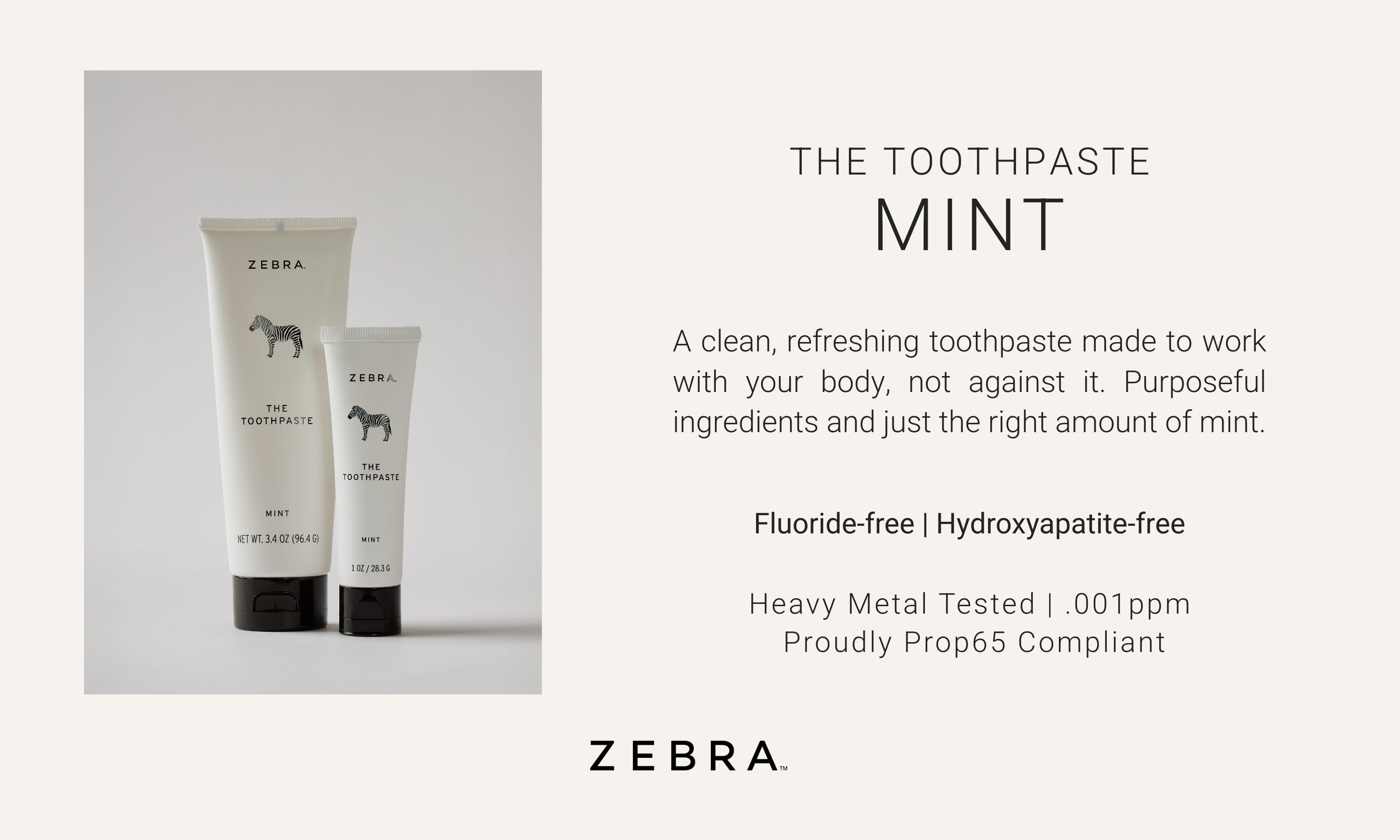
First and foremost, our favorite product is the toothpaste.
Available in coconut (Alex’s favorite) and mint, as well as birthday cake for kids.
Personally, my favorite Zebra oral care product is the tooth tablets.
I want to brush my teeth with dust from the ground.
And Zebra’s floss is made with silk and beeswax — which was a huge relief to me after finding out the most popular luxury floss in America is made with recycled plastic bottles, meaning people are depositing microplastics right into their gums every time they floss. (Fortunately, most people don’t floss as often as they should, if that’s any consolation.)
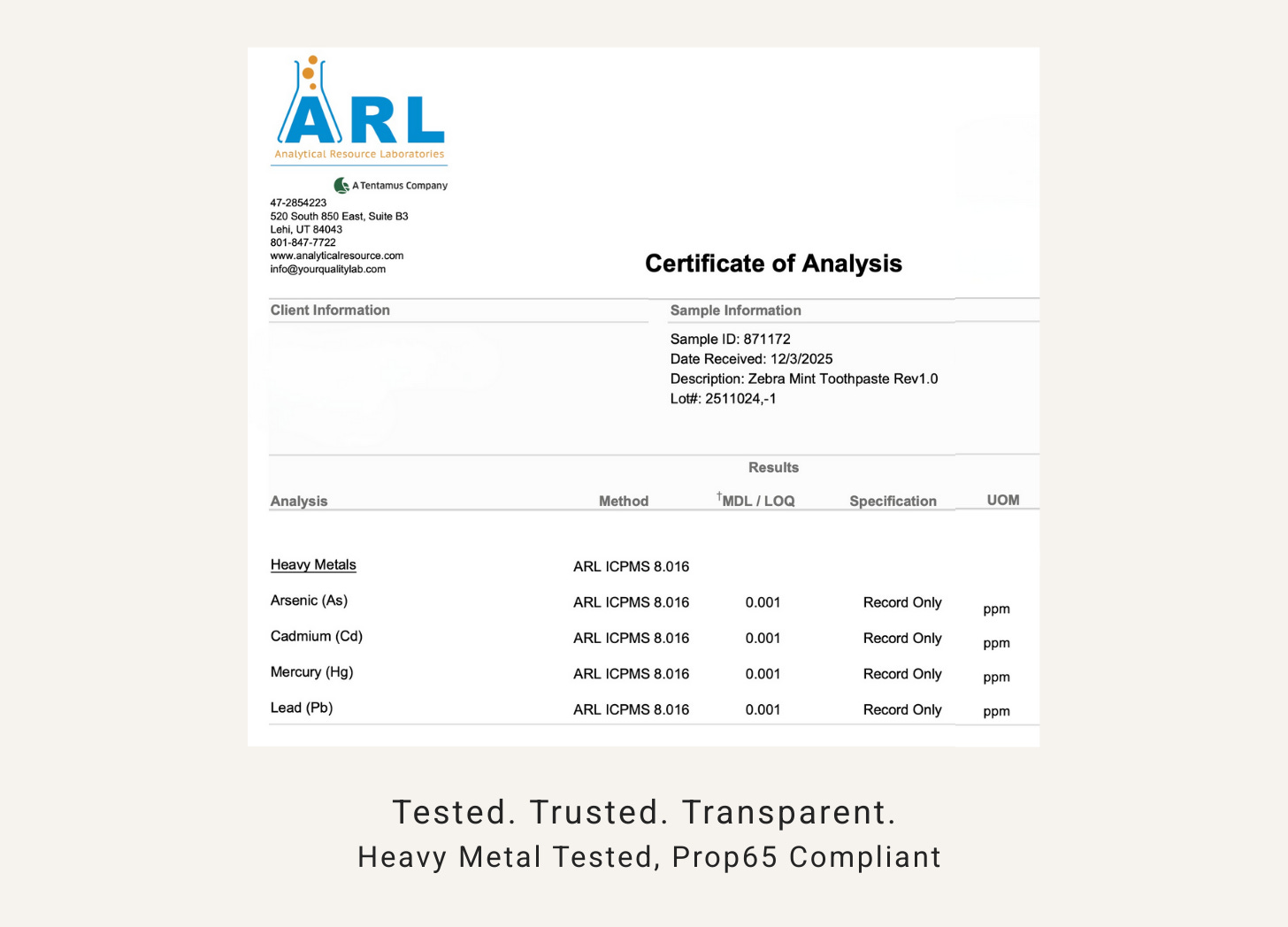
Speaking of dust from the ground — because Zebra uses natural ingredients derived from minerals, trace amounts of heavy metals can be present (much like for fruits and vegetables grown in the soil). Zebra uses independent third-party lab testing of their toothpastes to ensure the presence of heavy metals are extremely low, in compliance with Prop 65 in California, which has the strictest safety thresholds in the nation.
In addition to the oral care products, I love saving on shipping by ordering many of my staples from one company — my husband and I both use Zebra’s deodorant, and I also love their beauty products, including the eye cream and the lip gloss. The lip gloss (as well as the toothpaste) are housed in bio-based sugarcane plastic tubes, rather than petroleum-derived plastic.
In a world obsessed with hero ingredients, disruptive biohacking, and ever-more-complicated solutions to man-made problems, a simple and straightforward ingredient list feels truly revolutionary.
Sometimes the most preventative thing you can do is stop intervening and let the body remember how it was designed to work.
Sponsor Note: This article was created in partnership with ZEBRA. As always, sponsorship never influences our conclusions, it simply supports the continued creation of this work. If you’d like to support us, you can shop ZEBRA and use code GLITTER for 10% off.
Thanks for the article. I just bought some Zebra so we shall see how we like it. that and looking into diet as well as incorporating certain cell salts and I am super hopeful with my sons re Mineralization. I was wondering, what types of tooth brush you like? For you and your kiddos. Tooth brush type is another rabbit hole and I have not had a lot of success with more "natural" ones.
It is such a shame they do not ship to the UK. I am actually allergic to mint so I find it so difficult to find toothpaste I can tolerate so I was ecstatic when I saw the coconut version, but then quickly disappointed when I realised couldn’t actually order it.