


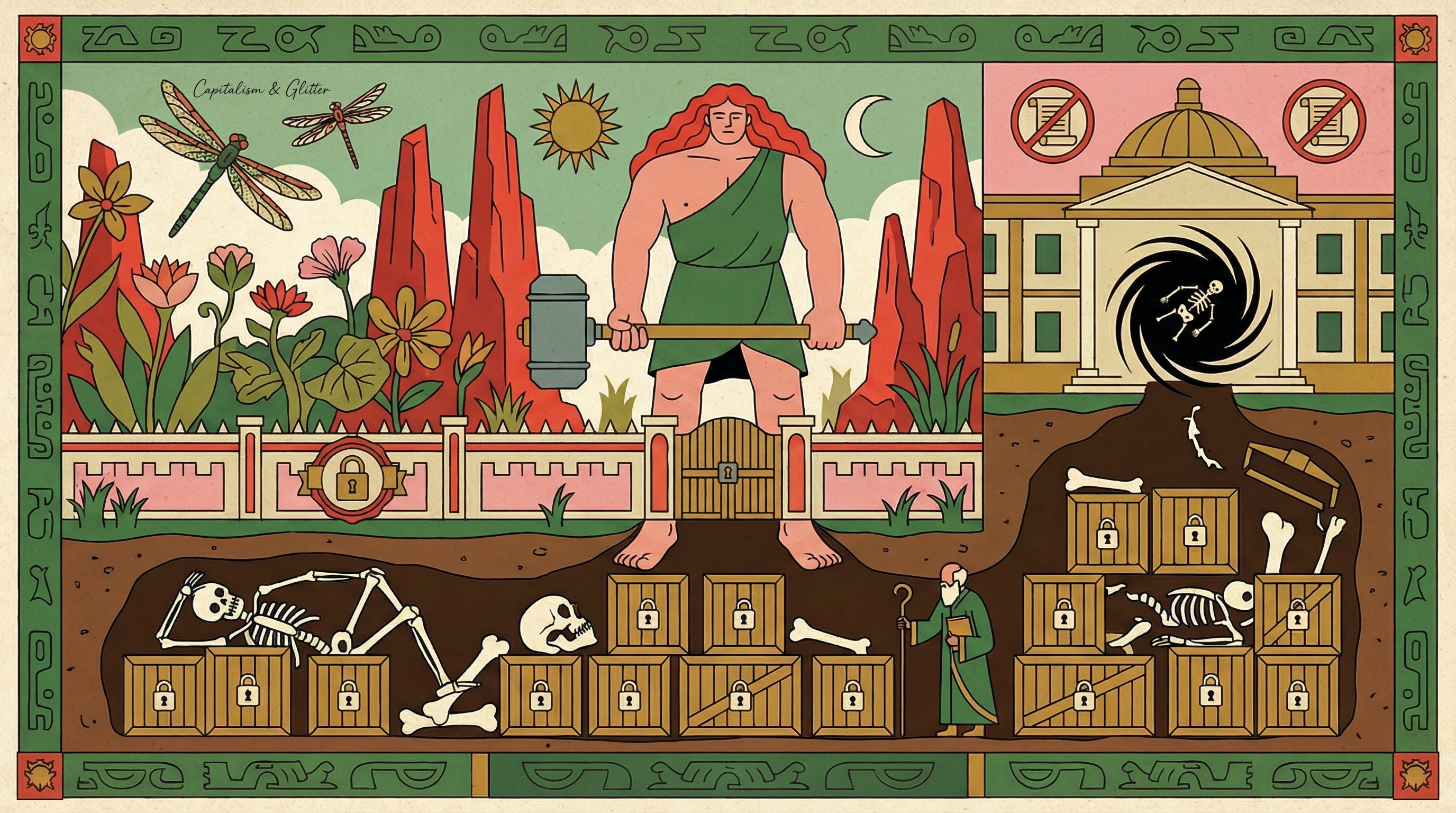
There is a specific kind of silence that hangs over certain parts of the American West.
We see it in the towering red rock spires of Sedona and the jagged peaks of the Sierras — landscapes that feel less like natural erosion and more like the handiwork of a physically larger civilization.
From the earliest campfire stories to the footnotes of forgotten excavation reports, the idea of giants has lingered at the edges of human history. Too consistent to ignore, yet too inconvenient to accept. Across continents and centuries, whispers of towering figures appear not as isolated curiosities, but as pieces of a pattern that refuses to fully disappear.
What if these accounts are not relics of imagination, but echoes of something real; something systematically dismissed, buried, or explained away?
To explore the possibility of giants is to step outside the comfort of the official narrative and into a far more unsettling question: not whether giants once carved their legacy into the red earth, but why we’ve been so thoroughly convinced they didn’t.
If you ask the modern scientific establishment, giants are nothing more than the fever dreams of ancient poets or the hoaxes of frontier hucksters.
We are told that history is a straight line of gradual progress, a neat narrative curated by institutions that guard the past with a ferocity usually reserved for state secrets.
But what if the “official” narrative is missing a chapter? What if the earth has occasionally coughed up evidence of a humanity that was larger, stronger, and far more mysterious than we are led to believe?
Tall Tales from a Wide World
The stories of giants are not a local anomaly, they are tales told in countless cultures across the globe.
In the oldest books of the Bible, the Nephilim (the mysterious offspring of the “sons of God” and the daughters of men) stalked the antediluvian (pre-flood) world. These were the Anakites and the Rephaim, lineages of such stature that the Israelite scouts famously claimed they felt like grasshoppers in their presence.
“And there we saw the giants, the sons of Anak, which come of the giants: and we were in our own sight as grasshoppers, and so we were in their sight.”
Numbers 13:33 (KJV)
We all know the story of David and Goliath, but we often forget that Goliath was merely the last of a line, a remnant of a physical reality that was once commonplace.
Across the ocean, tales of giants are echoed in the Greco-Roman Titans and the Norse Jötnar, representing more than just chaos; they represented an older, more primal version of the world. Even the Egyptians, who were meticulous chroniclers, left us the Anastasi I scroll — a 3,300-year-old document describing a terrifying group of people called the Shosu, residing in Canaan (where the Bible also places these giants), who stood over eight feet tall. The text doesn’t treat them as gods, but as a tactical nightmare for the Egyptian military.
This isn’t just ancient myth, either. In 1520, Ferdinand Magellan’s chronicler, Antonio Pigafetta, recorded an encounter on the coast of Patagonia with a man of “giant stature” so tall that the Spanish sailors only reached his waist. While modern skeptics dismiss this as “explorer’s embellishment,” later voyagers like James Byron confirmed seeing people of extraordinary height in the same region.
Why do we dismiss it as coincidence when disconnected cultures share similar stories, and call it myth when they describe the same physical details or specific evidence?
The Weight of Proof
If giants were real, they would have left more than stories.
They would have left physical evidence.
And they did.
Want more deep dives into the hidden corners of history and the mechanics of the “official” narrative? Subscribe to the Capitalism & Glitter Substack for weekly explorations into the intersection of culture, religion, and the things they’d rather you forget.