


As I near the end of my pregnancy with my third child, I am reflecting on just how much I have learned over the last 10 years through my fertility and pregnancy journey. From struggling with infertility followed by multiple undiagnosed chronic illnesses in my first pregnancy, to learning how to nourish myself properly and having relatively easy pregnancies just a few years later, my journey has truly transformed the way I think about my body, my fertility and health, and motherhood in general.
Some of the topics I will be sharing my thoughts on in the coming weeks and months as I explore this topic and answer commonly asked questions include:
Infertility
Nutrition
Prenatal Options
Iron Deficiency Anemia and Copper
Morning Sickness/Hyperemesis Gravidarum
Birthing
Post Partum Depression (PPD) and Post Party Anxiety (PPA)
Child Spacing
I am starting with the topic of nutrition as I know many people who are getting pregnant or trying to get pregnant right now, and I think this is an incredibly important topic that relates to preconception for both men and women, infertility, morning sickness, and PPD and PPA - essentially underlying nearly every issue one could have with fertility and pregnancy.
Pregnancy is a time of deep change - physically, emotionally, and mentally - and yet we are inundated with conflicting and confusing information about how our nutrition and overall health shape that experience and the outcomes.
I honestly used to be so confused about pregnancy nutrition, and relied on generic advice and conventional wisdom - much of which I have since learned is totally incorrect. After years of research, trial and error, personal growth, and being able to witness the impacts of my choices on multiple children, I am now confident in my approach to pregnancy nutrition and early child rearing.
And at 40 years old, I am currently experiencing my easiest and arguably healthiest pregnancy.
Where Conventional Advice Fails
The second a woman gets pregnant, or even starts trying, she will find herself overwhelmed with advice.
Eat this.
Avoid that.
Don’t drink coffee.
Actually, some coffee is fine.
It’s confusing, contradictory, and overwhelming.
Where do we even start?
I was so confused during my first pregnancy.
I had suffered multiple miscarriages before finally becoming pregnant with my daughter.
I saw an OB but didn’t fully trust the medical system - they had failed me in my youth, and had left me out to dry with infertility issues - essentially telling me that if I continued to have miscarriages, they could provide medications like Clomid or we could explore IVF, but not offering much in the way of understanding why I was having recurrent miscarriages, or what I could do about it in the meantime. I was simply told to struggle for a year so that I could then be diagnosed with infertility and offered drugs and other medical interventions.
And I didn’t trust “alternative” health practitioners either, having seen many people failed and taken advantage of by what appeared to be snake oil salesmen. I had previously experienced a bad reaction to acupuncture (I broke out in hives), I didn’t trust herbal remedies any more than I trusted pharmaceuticals, and I simply did not know which way was up.
Expecting Better
Feeling like I had nowhere left to turn - and juggling a high-pressure career where I was quickly rising through the ranks with little time or mental space to figure this all out (let alone a belief that I could figure this out on my own) - I turned to Emily Oster. She is an economist who fancies herself a pregnancy and parenting expert, despite having no background in health, nutrition, or prenatal care.
Emily Oster provides some of the worst advice on pregnancy health and nutrition. Because she’s an economist, she simply analyzes statistics and data, and because she doesn’t have a background in health in any way, she doesn’t understand the context of complex biology or physiological processes. She frequently uses appeals to authority, relying on conventional data and studies from large institutions like the CDC or ACOG who are subject to regulatory capture - and she is therefore prone to parroting marketing points over actually understanding and explaining nuanced scientific truths.
Emily Oster cherry-picks “expert” opinions that support her conclusions, and minimizes risk in the name of choice. She does this under the guise of empowering women - but what she’s actually doing is spreading misinformation and minimizing subtle but very real risks.
Three key examples of this are:
She says a little bit of alcohol in pregnancy is fine, because the data is “inconclusive.” She ignores that no safe threshold for alcohol in pregnancy has ever been established.
She downplays the importance of prenatal nutrition, relying on conventional wisdom and completely missing topics with nuanced but massive implications for fetal development. She emphasizes the importance of folic acid, a synthetic form of folate (Vitamin B9), but neglects to mention very common MTHFR gene variants, which renders approximately 40% of the population less or unable to process folic acid. These people require folate for better absorption and to avoid the birth defects associated with B9 deficiency.
She completely ignores micronutrients, the issues with synthetic vitamins and bioavailability, and how inadequate nutrition impacts placental development, birth outcomes, and postpartum recovery. She says any standard prenatal vitamin is fine.
Nutrition isn’t about statistics. It’s not about plausible deniability within the bounds of “limited studies.” It’s about how nutrients - vitamins and minerals - actually function in the body through biological processes. It’s about how those nutrients in turn influence your baby’s epigenetics, organ development, gut microbiota, etc. These things aren't captured in the surface-level "no statistically significant harm" lens.
Emily Oster lacks a grounded understanding of biological systems, fetal development, and how nutrition, toxins, and lifestyle choices interact over time.
But 10 years ago, I didn’t know any of this.
So I simply took a standard prenatal that I picked up at Rite Aid.
And then - when my daughter was 20 months old - I had a health crash so severe that I lost my high-powered career and became bedridden almost overnight, forcing me to relearn everything I thought I knew about health, biology, and the human condition.
I was gobsmacked to learn just how wrong the conventional wisdom was. And how it had undeniably harmed me and my child. And I was determined to never repeat those mistakes, ever again. (In a future article on morning sickness and hyperemesis gravidarum, I will discuss in depth precisely what those mistakes were.)
In early 2022, as I was climbing out of my health crisis, my husband and I were shocked to learn that I was pregnant.
After previously experiencing multiple miscarriages and secondary infertility, we unexpectedly got pregnant after having sex just once during a fertile window. That window fell right in the middle of one of the most stressful periods of our lives - moving across states with a toddler, all in pursuit of a better quality of life and improved health. I was still very sick, and unlike past attempts, I wasn’t tracking ovulation with apps or test sticks. I knew conception was technically possible, but I truly did not believe it was in the realm of possibility, especially not amidst the chaos. I had always assumed that stress outweighed everything else when it came to fertility. But as it turns out, the simple nutritional changes my husband and I had made mattered much more than I realized.
Nutritional status of both partners is by far the most important factor in fertility and pregnancy health.
I knew my nutritional choices had led to me fixing my fertility without even explicitly focusing on fertility - and I was determined not to repeat the same mistakes I made in my first pregnancy.
Trustworthy Nutrition Advice
As I began to seek out a midwife in my new town, I knew I needed to educate myself more on pregnancy nutrition. I had already spent years in between pregnancies digging into nutrition advice from people like Weston A. Price and Ray Peat - who focus on nutrient density, metabolic health, and prioritize real food - which had done wonders for my health and helped me to get pregnant without even trying. But I wanted to find a resource focused specifically on prenatal health.
By far the most helpful resource I found is the book Real Food for Pregnancy: The Science and Wisdom of Optimal Prenatal Nutrition by Lily Nichols.
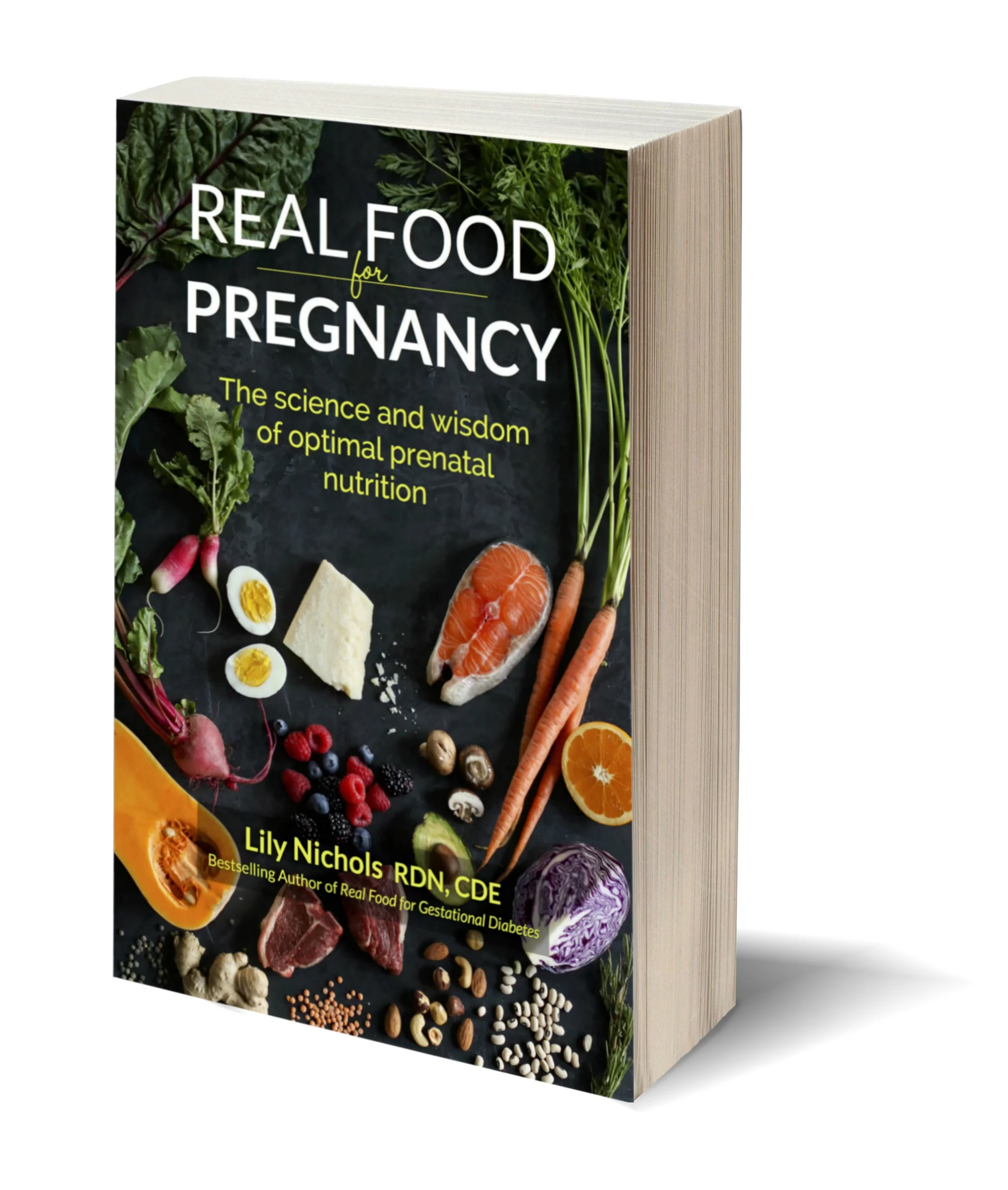
Lily Nichols is a registered dietician and mom who has also published a book on gestational diabetes, entitled Real Food for Gestational Diabetes.
Real Food for Pregnancy is an incredibly insightful discourse on optimal prenatal and pregnancy nutrition, presenting trustworthy and evidence-based nutrition advice in a clear and straightforward manner.
Basics of Pregnancy Nutrition
Pregnancy is one of the most nutrient-demanding seasons of a woman’s life. After three pregnancies between ages 33 and 40, multiple miscarriages, and a deep dive into ancestral nutrition, I’ve learned that real food is the foundation of a healthy pregnancy. Not prenatals. Not curated supplement stacks. Real, nutrient-dense food.
During pregnancy, there are three main goals your body is achieving:
Building a new organ system (the placenta)
Supplying nutrients to develop an entire human
Creating maternal nutrient reserves and increasing your blood volume by 50%
The maternal reserves come last. They are the least important thing during pregnancy, and your body will prioritize giving all the nutrients you have to your growing baby.
The most important thing you can do to support your nutritional needs is eat the recommended dietary allowances (RDAs) for pregnancy in your diet. In fact, prenatal vitamins are more for supporting the mother’s nutrient needs during pregnancy - real food and your vitamin and mineral stores before getting pregnant have a much higher impact on baby’s development directly. Many people over-rely on prenatal vitamins as a safety net, and sometimes a crutch, but their impact on your baby is much more minimal than your dietary intake.
In short, you cannot out-supplement a nutrient-poor diet.
Nutrients commonly under-consumed include:
Choline - critical for brain and neural development
Iron - for blood formation
Zinc, magnesium, copper, and iodine
Folate (Vitamin B9) and Vitamin B12
Omega-3 fatty acids (DHA)
High-quality protein
Keep in mind the RDA most commonly recommended is not the “optimal” level, it’s the bare minimum to prevent deficiency disease. The goal in pregnancy isn’t simply to avoid rickets or anemia; it’s to build robust, resilient babies, and support vibrant maternal health.
Below is a table comparing the standard RDA with Lily Nichols’ recommendations, and comments supporting dietary intake.
Lily Nichols’ RDA Recommendations in Pregnancy
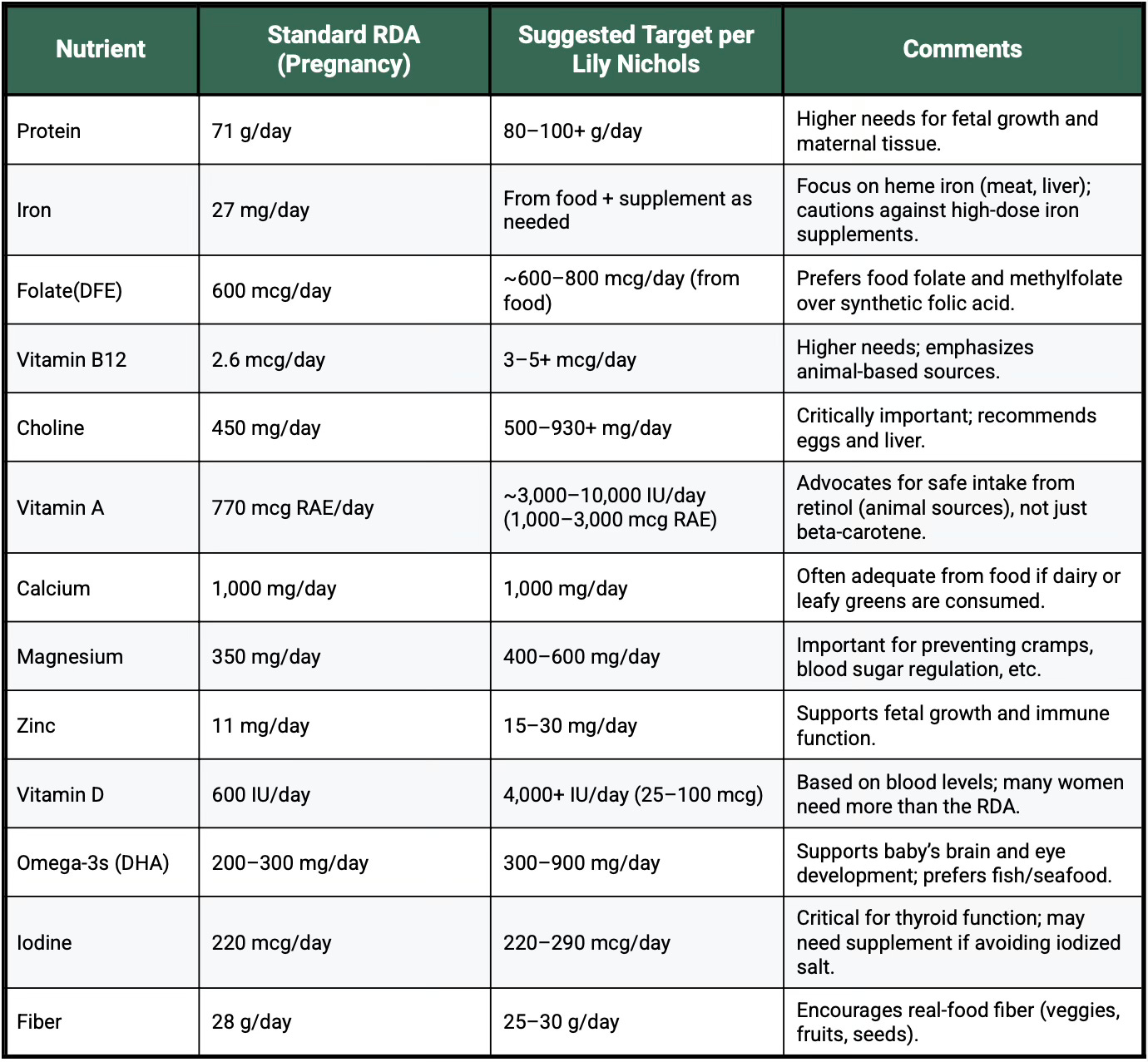
As you can see from the table above whole, unprocessed foods provide more bioavailable nutrients than supplements or fortified products. As well, animal-based foods like liver, egg yolks, seafood, and full-fat dairy are rich sources of critical micronutrients.
Additionally, carbohydrate needs vary between women and pregnancy diets should be individualized and not based on the food pyramid, and blood sugar balance, healthy fats, and protein matter deeply for both baby and mama.
Lily Nichols confirms through emerging research what ancestral traditions have long known - well-nourished mothers and babies start with food, not isolated, synthetic vitamins.
Dietary Supports
Some dietary recommendations for foods you can incorporate daily and weekly in pregnancy to support meeting the necessary RDAs include:
Daily
Egg yolks (rich in choline, vitamin A, DHA)
Full-fat dairy (for calcium, iodine, and vitamin K2)
Fresh fruit (rich in vitamin C, potassium, natural sugar)
Root vegetables (easy carbs for energy and blood sugar balance)
Grass-fed butter or ghee (vitamins A, D, K2, healthy fats)
Weekly
Grass-fed beef or chicken liver (2-4 oz 1–2x per week for B vitamins, iron, folate, copper, and retinol)
Red meat like grass fed beef, lamb, bison (3-5x per week for iron, zinc, B vitamins, carnitine)
Bone broth + slow-cooked meats (for glycine and collagen)
Shellfish like oysters, clams, shrimp (zinc, copper, selenium, iodine and B12)
Wild caught fish like salmon and sardines (DHA, selenium, protein) *avoid high mercury fish
Organic chicken with skin and bones (protein, glycine, collagen) tip: make bone broth with leftover bones
Other Dietary Supports
Raw carrot salad to support gut health and digestion, fiber, and estrogen detox (shred carrots and prepare with vinegar and olive oil)
Fermented foods like yogurt, kefir, sauerkraut to support gut health with probiotics and and enzymes
Sea salt and other electrolytes as needed to support fluid and mineral balance
Spring and mineral water to support fluid and mineral intake
Conclusion
Prenatal nutrition is the most important thing you can learn about for preconception and pregnancy health, for both mother and baby.
The simple truth is that your first child is always a test run. You will inevitably learn a lot the first time you do anything, and - if you are introspective - you will likely make changes the second, third time around. That’s life. If you are realizing you made mistakes, give yourself grace to keep learning and change your mind. When we know better, we do better.
Whether you're a first-time mom or well into your parenting journey, I hope these insights encourage you to advocate for your health and nourish yourself well and with intention.
What questions do you have on pregnancy nutrition? Are there other pregnancy and fertility topics you want me to cover in the future? Let me know in the comments below!
xoxo Adrian
Explore related articles in our Pregnancy Health series at the links below:
Pregnancy Health: On Supporting Fertility
Pregnancy Health: On Prenatals
Pregnancy Health: On Morning Sickness and Hyperemesis Gravidarum
This is soooo good, Adrian. I bought the book after you recommended on IG. We made a lot of small nutrition changes to our diet in the past 6-12 months and I got pregnant again without even trying. I still have morning sickness this go around but certainly not as bad as with my second child and I think it’s because of my nutrition.
With my second, we were trying for a few months and the instant I completely changed my diet, prioritizing animal based meals, fruits and some veggies, lots of healthy fats and animal based fats, full fat dairy, cut alcohol completely and focused on my mental, we got pregnant quickly. I could go on and on but just wanted to echo how crucial pre-pregnancy nutrition is.
This is so so helpful! Thank you! I recently found out I was pregnant (very big surprise—we weren’t trying) and am still breastfeeding my almost two year old. 😅 Getting enough food in my body while having some big food aversions in the first trimester has been especially difficult. I have had to cut out dairy while breastfeeding due to my toddler having a sensitivity. 😩 Pretty positive my toddler also has the MTHFR gene mutation so I’m really trying to do my best this time around to support new baby. Do you have recommendations for an alternative option to the nutrients found in dairy? Currently trying to wean but it’s taking some time. I’m also eating the nunona prenatal bites thanks to your recommendation 😊