

The Curious Case of Lyme's Emergence in Connecticut
How did Lyme disease show up seemingly out of nowhere? And why does it make some people so sick?


I got Covid in March 2020.
I didn’t know a single other person (besides my husband and daughter) who had Covid at that time. It was the weirdest illness I had ever experienced, and there was little to no information about other people’s experiences with the illness, let alone the aftermath.
What followed was 16 months, 13 doctors (most of whom I eventually fired), more than 100 tests, and a rotating cast of syndrome diagnoses — each one consisting of several symptoms I had on a small scale pre-Covid, and feeling like a consolation prize from a medical system that couldn’t figure out what was actually wrong with me.
Then, finally, a supposed root cause:
Lyme disease.
But I had never had a tick bite. I had no memory of exposure, no telltale bullseye rash — just a diagnosis that arrived like a missing puzzle piece, and immediately generated a hundred more missing pieces.
How did I get it? Unclear.
How long have I had it? Unknown — possibly my whole life, since it can be passed along congenitally from mother to baby.
Which means the question isn’t just when I got it. It’s how far back this line actually goes.
Symptoms I’d carried for decades, things I’d been told were just me — genetic quirks, familial anomalies like cherry angiomas, the same ones my mom has — suddenly reframed as possible Lyme co-infection (Babesia) markers that no one had ever thought to connect.
And when I started pulling that thread — where did Lyme come from? — I ended up somewhere I wasn’t expecting. Somewhere involving a tick biology researcher who spent his career sitting on a secret, a remote island with a classified history, and a pathogen that doesn’t officially exist in the United States.
The Fastest-Growing Infectious Disease You’re Probably Misunderstanding
The mainstream story on Lyme is tidy, woefully incomplete at best, and harmfully incorrect at its worst.
A tick bite, which can only transmit Lyme after 24 hours (false), only indicates Lyme if it results in a bullseye rash (also false), which can easily be cleared up with two to four weeks of doxycycline (false, false, false).
The CDC still does not recognize Chronic Lyme disease as a disabling diagnosis — despite the fact that a significant percentage of treated patients continue to experience debilitating symptoms long after antibiotics are complete. The medical establishment has a name for this that manages to acknowledge the experience while simultaneously dismissing it: Post-Treatment Lyme Disease Syndrome, or PTLDS. It’s a diagnostic category that essentially means we believe you had Lyme, we believe you’re still sick, and we have nothing more to offer you.
What the tidy story doesn’t address is the symptom range. Lyme disease can cause, or mimic, nearly every condition in the medical textbook — autoimmune conditions like rheumatoid arthritis, every psychiatric diagnosis in the DSM, neurological symptoms from facial palsy to seizures, and cardiac complications including sudden death. Researchers have linked it to everything from anorexia, to suicide, to Parkinson’s-like presentation.
It also does something very unusual for a bacterial pathogen: it uses manganese instead of iron for its metabolism. Most bacteria survive on iron, and one of the body’s primary immune defenses is to sequester iron out of your blood and into your tissues precisely to starve out infection. Borrelia burgdorferi sidesteps that entirely. It’s a bacterium that has somehow, inexplicitly, evolved to defeat one of your oldest immune strategies before your body even knows it’s there.
Intergenerational Pathology
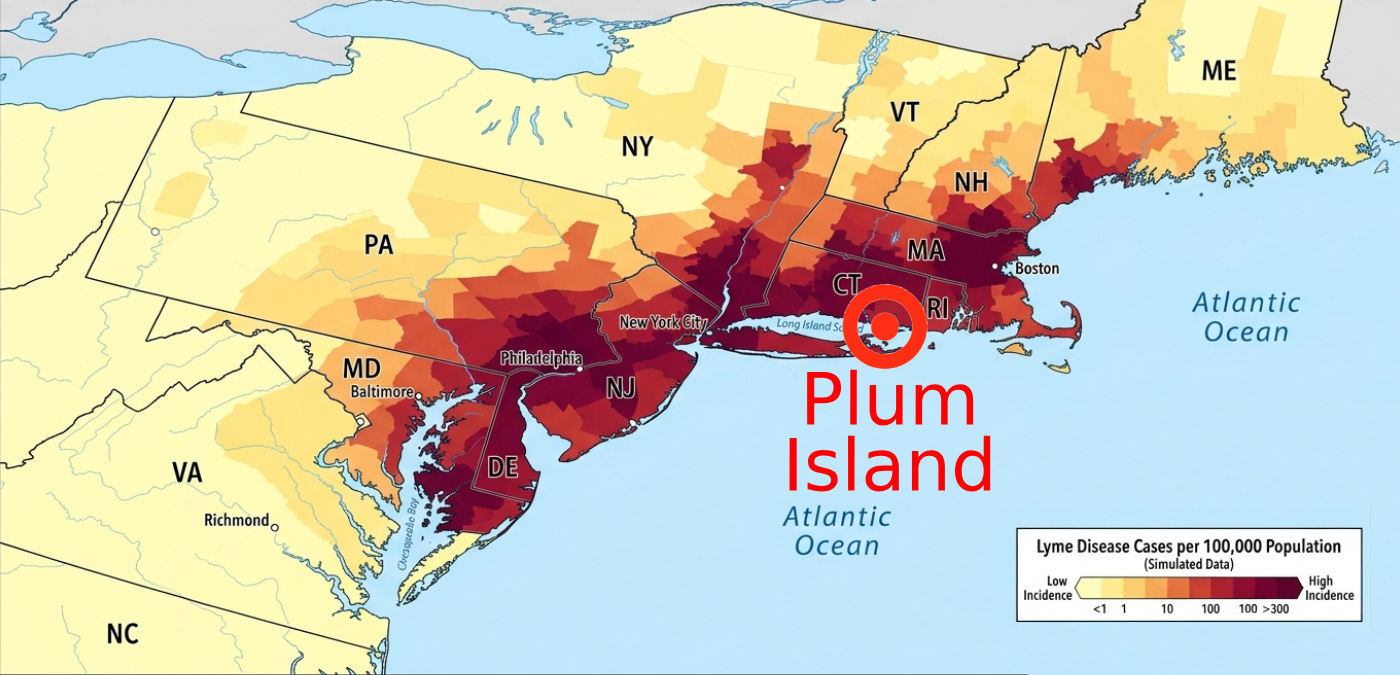
My mom was born in Massachusetts and grew up traipsing through the marshy wooded areas — specifically in the region just above Cape Cod, at the center of what the CDC’s own maps show as one of the darkest endemic clusters of both Lyme disease and Babesiosis, a co-infection that travels alongside Lyme and is caused by a malaria-like parasite transmitted by the same black-legged tick.

I grew up in Northern California. Which certainly has ticks, and there are claims that the CDC doesn’t count all the cases in the South and the West on their map. But, given that I never had a tick bite, the most likely origin of this pathogen for me is congenital Lyme transmission from mother to child during pregnancy. The research is contested (as most Lyme research is), but the mechanism is biologically plausible: Borrelia has shown it can cross the placental barrier. Stillbirths, miscarriages, and neonatal complications have been linked to maternal Lyme infection. Lyme Literate Medical Doctors are well aware of this, and they do not contest this possibility as they see it so often.
So if my mom grew up in the highest-endemic region in the country, and congenital transmission is real, the question isn’t just do I have Lyme disease? It’s: does she? Did her mother, who also struggled with health issues and dabbled in holistic medicine? How many generations back does this go? How many symptoms got explained away as just how we are — the fatigue, the joint pain, the neurological flares, the anxiety — when the actual answer was a spirochete that traveled down the family line?
As if that wasn’t enough, here’s what actually stopped me in my tracks mid-research and made me sit straight up in my bedridden state of existence.
Look at a map of Lyme and Babesiosis endemic zones in the United States. There’s a dense, dark cluster on the Eastern Seaboard — concentrated around southern New England, coastal Connecticut, Long Island, the Jersey Shore. The center of that cluster — the bullseye of the bullseye, if you will — sits directly around the eastern tip of Long Island.
Where, at the very end of that island, sits Plum Island.
The Island Nobody Wants to Talk About
Plum Island Animal Disease Center is a federal government research facility. It sits roughly two miles off the coast of Orient Point, New York — in the Long Island sound just off the coast of Connecticut, accessible only by ferry, historically classified, and officially dedicated to studying “foreign animal diseases” that might threaten American livestock.
That’s the official version.
Capitalism & Glitter is a reader-supported publication.
If you’d like to support us and receive deep dives like this one directly in your inbox, please consider a paid subscription.
Paid subscribers receive:
Full-length weekly health, Biblical, cultural, and archaeological deep dives
The Edit newsletter, and access to all community chats
The entire archive of content on health and wellness, secret societies, and more (75+ articles)
Discounts on merch and upcoming ebooks