

This Week
We are reading:
Deuteronomy 27-34
John 1-12
Psalms 149-150, Proverbs 5-6:11
Summary
Whew! What a slog through the Torah but WE. MADE. IT.
Reading through the Bible in a year is one thing, but writing my thoughts on it every week is another. I, too, feel as though I’ve been wandering through the desert for 40 years.
And yet here I am — making summer plans for a road trip with three kids through the American west — my own little desert wandering adventure.
All that to say: sorry this article is a day late this week, and Happy Easter to you and your families!!
On to the Bible notes.
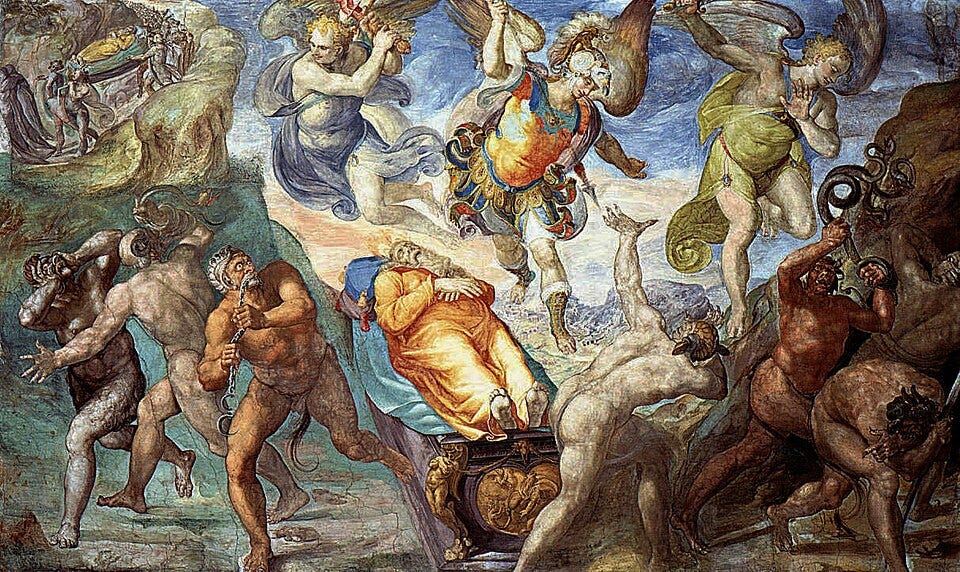
As we wrap up Deuteronomy, completing Moses’ narrative in these first five books of the Bible, one of the most interesting things we are reading this week is what is commonly referred to as the Deuteronomy 32 worldview. This is further validation of the story told in early Genesis and Enoch, where we learn about the supernatural conflict between the fallen angels and the humans who have dominion over the earth. In Moses’ final words, he details how God disinherited the rebellious nations at Babel, assigning them to lesser divine beings ("sons of God") while creating Israel as his own portion.
This explains why other nations worship lesser gods/demons instead of Yahweh, why idolatry is the worship of demons and receives a strong focus, and how spiritual warfare underscores the very conflicts we see between nations today.
And on that note — I am so excited to be wrapping up this section of the Bible and jumping to our very first Messianic Checkpoint with the Gospel of John!
Thank God Jesus is finally here to reverse the fallout of Babel and take back the nations.
The Gospel of John is markedly different from the other 3 Gospels detailing Jesus’ life — Matthew, Mark, and Luke, collectively called the Synoptic Gospels. The Synoptic Gospels detail what Jesus did, whereas John details who Jesus is.
John was written much later, is much more direct about Jesus’ identity as the son of God, and focused on validating that identity by documenting His miracles. It is presumed that the author didn’t want to repeat the other Gospels and was addressing an audience of heretics. John also specifically names names where the other gospels didn’t, but that won’t come up until next week’s readings.
Note to my future self, as I evolve this Bible study for next year: I gotta say, I wish I had cut about 10 days out of the plan earlier (maybe skipping Jubilees?) so we could have read John in the lead up to Easter. I might do that next year.
I really love ending the Torah and then reading one of the Gospels. It’s such a great reward. It helps us make connections. I just can’t wait 30+ more books for Jesus and I truly feel bad for the suffering Israelites. And while I definitely think the story of the entire Bible is fascinating and of course worth reading and studying, I also think if you just read the Torah, the first section of Enoch (1-36: Book of the Watchers), a few of the Gospels and Acts — you would have the outline of early world history and the baseline of the spiritual warfare we find ourselves within. You wouldn’t have the details, but you would have the shape of things.
This Bible study is free for everyone, made possible by the support of our paid subscribers.
If you’d like to support us, please consider a paid subscription. Paid subscribers receive:
Full-length weekly cultural and Biblical deep dives
The Edit weekly newsletter, and access to all community chats
The entire archive of content on health and wellness, secret societies, and more (50+ articles)
Here is the daily breakdown from our annual plan:
Day 96 — Monday, 4/6 — Deuteronomy 27-28, Psalm 149
Day 97 — Tuesday, 4/7 — Deuteronomy 29-31, Psalm 150
Day 98 — Wednesday, 4/8 — Deuteronomy 32-34, Proverbs 5:1-6
Day 99 — Thursday, 4/9 — John 1-3, Proverbs 5:7-14
Day 100 — Friday, 4/10 — John 4-6, Proverbs 5:15-23
Day 101 — Saturday, 4/11 — John 7-9, Proverbs 6:1-5
Day 102 — Sunday, 4/12 — John 10-12, Proverbs 6:6-11
Day 96 — Monday, 4/6 — Deuteronomy 27-28, Psalm 149
Moses and the elders command Israel to set up plastered stones with the Law written on them once they enter the promised land.
The Levites proclaim twelve curses for hidden sins — and all the people say, “Amen.”
Detailed blessings are given for obedience, with very specific curses for disobedience.
Foreshadowing! Exile is foretold if Israel is unfaithful to God. Gee, I wonder what’s going to happen next.
I am making this covenant with you so that no one among you—no man, woman, clan, or tribe—will turn away from the Lord our God to worship these gods of other nations, and so that no root among you bears bitter and poisonous fruit.
Deuteronomy 29:18
Day 97 — Tuesday, 4/7 — Deuteronomy 29-31, Psalm 150
God renews the covenant with Moses and Israel in Moab.
Israel is once again warned about idolatry and secret sin.
God promises restoration of Israel after exile.
Moses prepares for death and commissions Joshua as the next leader of Israel.
Today I have given you the choice between life and death, between blessings and curses. Now I call on heaven and earth to witness the choice you make. Oh, that you would choose life, so that you and your descendants might live!
Deuteronomy 30:19
Day 98 — Wednesday, 4/8 — Deuteronomy 32-34, Proverbs 5:1-6
Moses delivers the Song of Moses, recounting God’s faithfulness and Israel’s failure.
Alright now we’re getting to the interesting part of this week’s reading: the Deuteronomy 32 worldview. Wherein God divided humanity among multiple spiritual beings (often understood as angels or divine council members) and personally chose Israel as His own inheritance. The other nations are under lesser spiritual rulers, who become corrupt and lead nations into idolatry.
NOTE: Some of your Bibles might say “sons of Israel” in Deuteronomy 32:8, but the original in Hebrew is the infamous bene Elohim — sons of God. This passage is talking about the events of the Tower of Babel, Israel didn’t even exist! How could God have divided the nations based on the sons of Israel!
Despite the Israelites turning away, sacrificing to demons and whatnot, God will ultimately vindicate His people.
Moses blesses the tribes of Israel, then God shows him the promised land that he will not enter.
Moses dies, God buries him in Moab, and Joshua succeeds him.
When the Most High gave to the nations their inheritance, when he divided mankind, he fixed the borders of the peoples according to the number of the sons of God.
Deuteronomy 32:8 (ESV)
Day 99 — Thursday, 4/9 — John 1-3, Proverbs 5:7-14
The Gospel of John opens with the Word becoming flesh
John the Baptist testifies to Jesus’ arrival
The first disciples begin to follow Jesus after his recognition from John the Baptist
Jesus performs his first miracle — turning water into wine at the wedding of Cana, at the insistence of his mother (a nice inclusion of Mary since John completely skips the immaculate conception — again, probably to avoid repeating stories contained in the synoptic gospels)
Jesus sees dealers and merchants selling goods in the temple and is furious they have turned His father’s house into a marketplace, so he fashions a whip and chases them all out
The Jewish leaders are furious at this and Jesus tells them to destroy the temple and that he will rebuild it in three days — a veiled reference to his ressurection, which the disciples will later remember
For God so loved the world that he gave his one and only Son, that whoever believes in him shall not perish but have eternal life.
John 3:16
Day 100 — Friday, 4/10 — John 4-6, Proverbs 5:15-23
Jesus reads a Samaritan woman at Jacob’s well for having had 5 husbands and not being married to the man she’s currently living with — but he connects with this outsider by choosing to reveal to her that He is the Messiah and selecting her as the missionary to the Samaritans, a group at odds with the Jews — ultimately showing that Jesus has come to heal and redeem all the nations
Jesus heals a sick man on the Sabbath, pissing off the Jewish leaders yet again
Jesus feeds 5,000 people with 5 loaves of bread and 2 fish
Jesus walks on water
Jesus tells the people in Capernaum that he is the bread of life and that anyone who eats the bread of life will live forever in Heaven. Several disciples say this is too hard to understand and desert Him. You guys want to discuss the Eucharist in the chat?
Day 101 — Saturday, 4/11 — John 7-9, Proverbs 6:1-5
Jewish leaders argue over whether Jesus is the Messiah
The story of the adulterous women in John 7:53-8:11 was not included in the earliest manuscripts. Some of the early church fathers believed the story likely reflected an actual Jesus story that circulated for a long time before it was documented in this Gospel — so it’s likely historically accurate if not authentic to this original manuscript.
Jesus heals a blind man, again on the Sabbath, and accuses the Pharisees of spiritual blindness
Day 102 — Sunday, 4/12 — John 10-12, Proverbs 6:6-11
Jesus raises Lazarus from the dead — ultimately triggering the series of events that leads to his crucifiction
Jesus, riding a donkey, enters Jerusalem to a crowd carrying palm leaves — on a day that will be memorialized as Palm Sunday
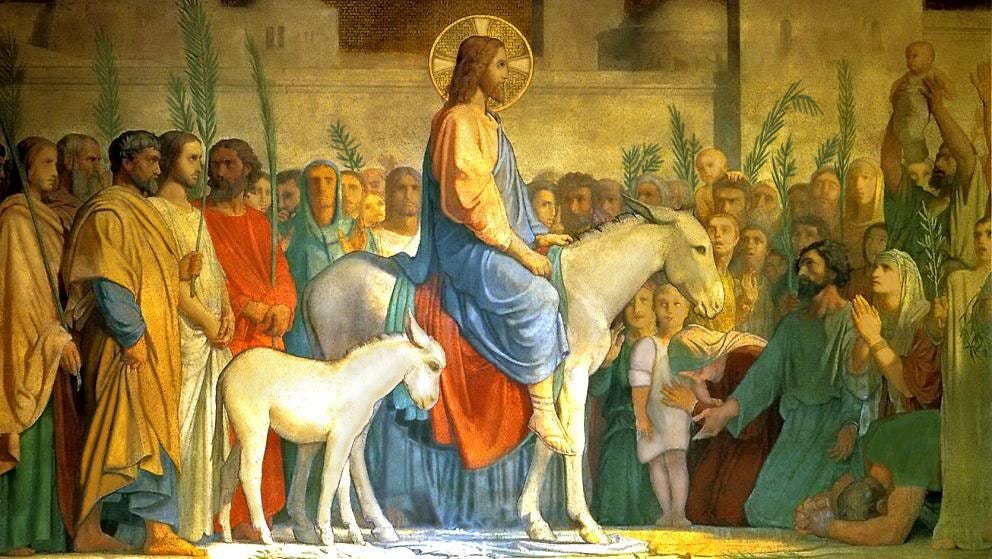
I couldn’t wait for Jesus any longer either! I’m so glad we’re jumping into John next ❤️
I truly appreciate the beautiful, moving artwork you include in these posts. I recently went to MFAH and soooo much art is inspired by the stories of the Bible (and so many of Mary!). It’s so important we engage the Word with all our senses 😊.