


This Week
We are reading:
Mark 11-16
1 Kings 12-22
2 Chronicles 10-12
Psalms 67, 68, 22
Song of Solomon 1-4
Summary
This week we open with the final week of Jesus’s life in the conclusion of the Book of Mark.
Interestingly, the oldest manuscripts of the Gospel of Mark ended at 16:8 — with the women fleeing from the tomb in fear. You’ll notice your Bible continues to Mark 16:20. Mark was the first written Gospel, and Biblical scholars widely agree that these passages were added later, likely by a scribe who was familiar with the later events (Mark 16:8-20 discusses events covered elsewhere in the New Testament, particularly the Book of Acts).
When Mark was first written, the author likely intended the ending to be a somber look at how we humans fall short of doing right by Jesus. The later Gospel writers ease up a bit on criticizing human failures in the face of God. While some people point to this as evidence of the Bible being manipulated, I personally don’t see anything particularly conspiratorial in the added passages — it just reads like a later Christian trying to round out the Book of Mark in hindsight with a more complete ending.
Then we’re back in 1 Kings, and the kingdom that Solomon built is about to split in two. His son Rehoboam makes one catastrophically arrogant decision and loses ten tribes in an afternoon. The north and south will never reunite. But, at least we get to meet Elijah.
The Song of Solomon threaded through the second half of the week is its own thing entirely — ancient love poetry, read in Jewish tradition as an allegory of God’s love for Israel, in Christian tradition as Christ and the church. Or, you know, a poem about two people in love. Possibly all three at once.
This Bible study is free for everyone, made possible by the support of our paid subscribers.
If you’d like to support us, please consider a paid subscription.
Paid subscribers receive:
Full-length weekly cultural and Biblical deep dives
The Edit newsletter, and access to all community chats
The entire archive of content on health and wellness, secret societies, and more (75+ articles)
Here is the daily breakdown from our annual plan:
Day 159 — Monday, 6/8 — Mark 11-12, Psalm 67
Day 160 — Tuesday, 6/9 — Mark 13-14, Psalm 68
Day 161 — Wednesday, 6/10 — Mark 15-16, Psalm 22
Day 162 — Thursday, 6/11 — 1 Kings 12-15, Song of Solomon 1
Day 163 — Friday, 6/12 — 1 Kings 16-19, Song of Solomon 2
Day 164 — Saturday, 6/13 — 1 Kings 20-22, Song of Solomon 3
Day 165 — Sunday, 6/14 — 2 Chronicles 10-12, Song of Solomon 4
Day 159 — Monday, 6/8 — Mark 11-12, Psalm 67
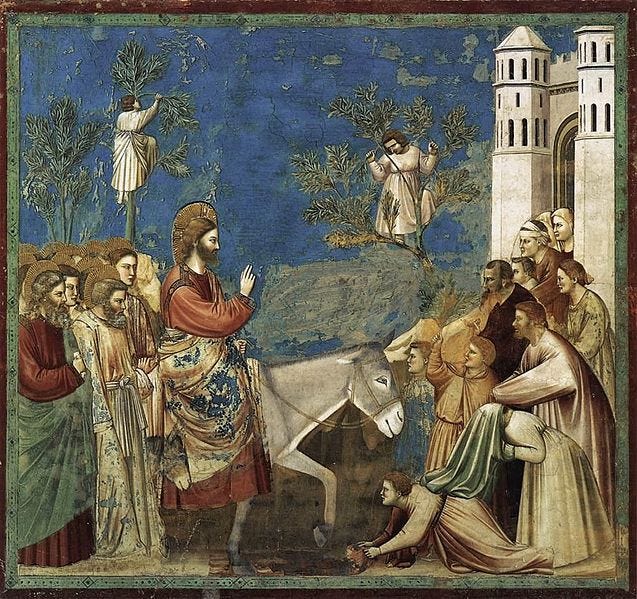
Jesus enters Jerusalem on what we now know as Palm Sunday
Jesus curses a fig tree that has no fruit, and clears the temple by overturning the money changers’ tables and driving out the merchants.
The religious authorities are looking for a way to kill Jesus and He is now operating entirely in public.
Jesus watches a rich person make a large donation and a poor widow put in two small coins and says she gave more than all of them — a commentary on the true meaning of giving and generosity.
Day 160 — Tuesday, 6/9 — Mark 13-14, Psalm 68
Jesus sits on the Mount of Olives and describes for his disciples the destruction of the temple and the end of the age. This prophecy was fulfilled in 70 AD when Rome destroyed Jerusalem — which is likely when the Book of Mark was written, and why the author had a more apocalyptic view when writing his Gospel.
A woman anoints Jesus’s head with expensive perfume. The disciples are indignant about the waste, but Jesus says what she has done is beautiful. So you heard it straight from Jesus — aesthetics in worship and in life have genuine intrinsic value.
We re-read another telling of the Last Supper, Gethsemane, and the arrest. Peter was the most likely source material for the Book of Mark so this re-telling of Peter’s three denials, and his reaction at the end of breaking down and weeping, are details that probably came directly from Peter.
Day 161 — Wednesday, 6/10 — Mark 15-16, Psalm 22
Psalm 22 on the same day as the crucifixion account in Mark is no accident. It was written by David a thousand years earlier and it references the crucifixion in details that are impossible to explain away — “they pierce my hands and my feet... they divide my garments among them.”
Even with the additional ending to Mark, this Gospel ends abruptly and in a bit of despair — which is probably what the author truly felt in 70 AD after the destruction of the temple.
Day 162 — Thursday, 6/11 — 1 Kings 12-15, Song of Solomon 1
Solomon is dead and his son Rehoboam goes to Shechem to be confirmed as king.
The people send Jeroboam to ask Rehoboam to lighten the forced labor assigned by Solomon. He consults the elders, who tell him to listen. He consults his young friends, who tell him to come back harder. He listens to his friends — and loses ten tribes in a day. The United Kingdom of Israel lasts exactly three reigns.
Jeroboam becomes king of the northern ten tribes (Israel) and immediately makes two golden calves, telling the people these are the gods who brought them out of Egypt, and sets up unauthorized worship sites so the people won’t travel south to Jerusalem. Hmm, I feel like we’ve read this story before.
Day 163 — Friday, 6/12 — 1 Kings 16-19, Song of Solomon 2
The northern kingdom rapidly cycles through a half a dozen kings (hey! that’s the name of the book!), eventually landing on Ahab. Ahab marries the infamous Jezebel, a Phoenician princess who brings her gods with her, and the text says Ahab did more to provoke the God of Israel than all the kings before him.
Elijah appears before Ahab and announces a drought. Then he disappears into the wilderness and God sends ravens to feed him.
Elijah goes to Ahab and challenges 450 prophets of Baal and 400 prophets of Jezebel on Mount Carmel. The first to get their god to produce fire wins. The prophets of Baal shout and dance and cut themselves all morning, but get nothing in return. Elijah mocks them, saying, “Call your god louder, maybe he’s on vacation or in the bathroom.” Elijah drenches his altar in water three times and then prays one straightforward prayer, and fire falls and consumes everything. Looks like the real God won.
Then Jezebel sends a message to Elijah: you’ll be dead by tomorrow. Elijah runs into the wilderness and asks God to let him die. Even a guy who just called fire from heaven is overwhelmed with worldly threats. God sends an angel with food instead.
Day 164 — Saturday, 6/13 — 1 Kings 20-22, Song of Solomon 3
Two wars against Aram, both won by Israel despite being the smaller force — the text is explicit that God is engineering the victories to show that he is not merely a god of the hills.
Ahab and Jezebel orchestrate a takeover of Naboth’s vineyard when he won’t sell his ancestral land; Elijah shows up immediately to issue divine justice from God.
Ahab’s response is genuine repentance and God delays the judgment a generation.
Ahab wants to retake Ramoth-Gilead. Four hundred prophets tell him he’ll succeed, but one prophet notorious for prophesying bad things for Ahab tells him otherwise. Ahab dies in battle, shot by an arrow between the sections of his armor. Dogs lick his blood from the chariot, exactly as Elijah said. Whew.
Day 165 — Sunday, 6/14 — 2 Chronicles 10-12, Song of Solomon 4
We’re bouncing around between books because we are reading the Bible chronologically — so, fittingly, we’re jumping back to Chronicles, which covers the kingdom split we just read about in Kings, but then pivots to focus almost entirely on Judah, the southern kingdom. The north largely disappears from Chronicles’ story. The Chronicler’s interest is the line of David and the temple in Jerusalem.
Rehoboam fortifies cities throughout Judah and then, once he’s established, abandons the law. The Egyptian pharaoh Shishak invades and takes the treasures of the temple, including the gold Solomon accumulated. Rehoboam replaces them with bronze shields.
Song of Solomon is steaming up, I don’t even know what to say about it.
What did this week leave you thinking about? Mark's extra ending, Elijah saying Baal was probably unavailable on the toilet, Song of Solomon’s borderline erotica, or something else entirely? Tell me below or in the chat!
haha the borderline erotica- at first I was like… “the bride is the church? The flock?” but that metaphor… became difficult when breasts were mentioned😬🤣 and choice fruits…
Making fun of the gods was fantastic too!