


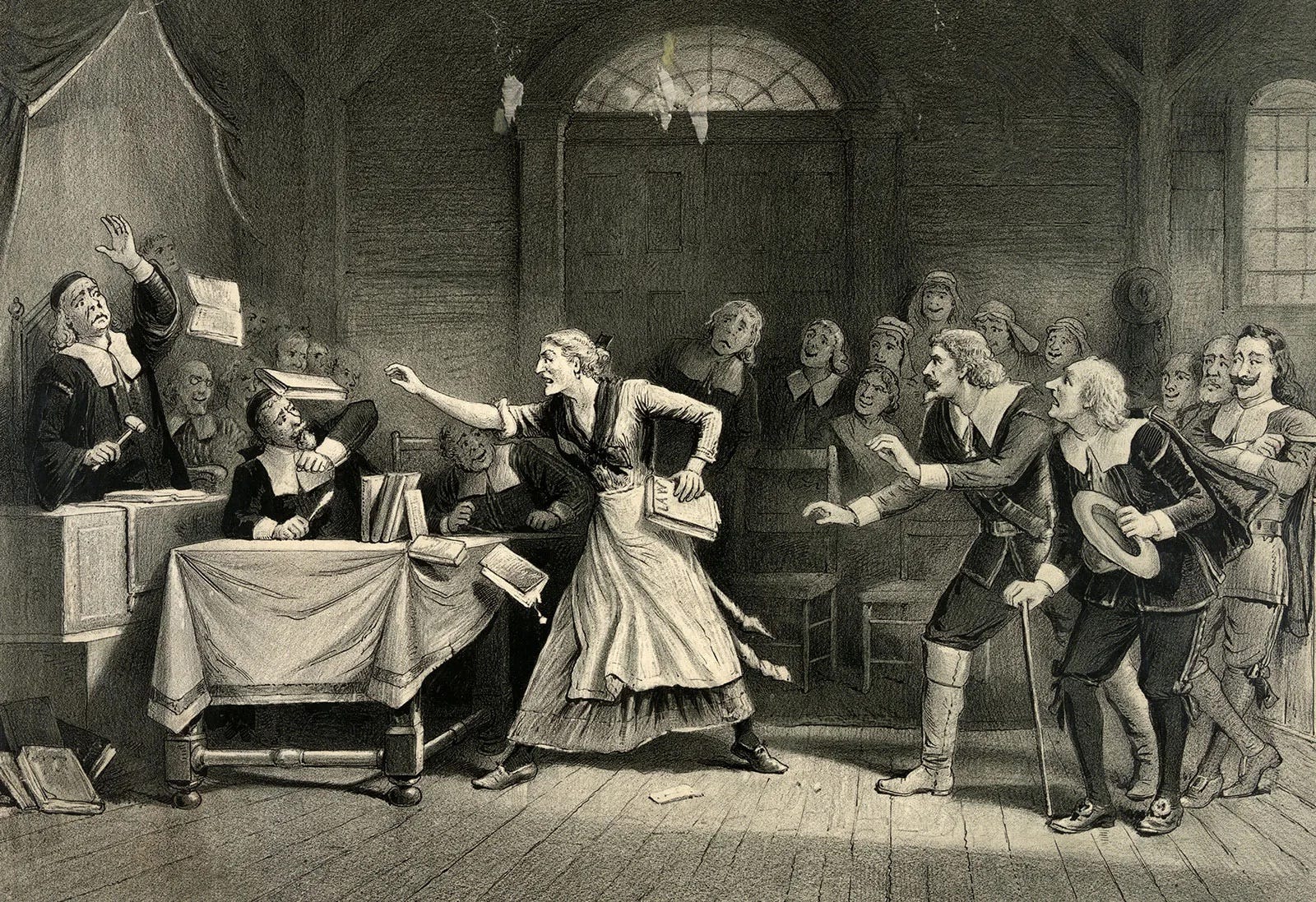
History loves to call the Salem Witch Trials a tragedy of superstition — a few hysterical girls and a community caught between tumultuous theology and shifting culture.
That’s the polished, Sunday school version that people tell when they want everyone to feel relieved that we’ve “moved past” this kind of mass formation psychosis.
But peel back the layers of Puritan lace and Salem looks less like a town bewitched, and more like a land dispute driven by powerful men, fueled by a psychoactive fungus, wrapped in scripture.
Act I: The Devil Went Down to Salem
John and Elizabeth Proctor.
Rebecca Nurse.
Mary Eastey.
What did they have in common?
They were all hanged for witchcraft in Puritan Salem.
And they all had significant land holdings.
Salem Village, 1692: a clearing hacked from the Massachusetts woods, hemmed in by cold, wet fields, warmed only by fervent gossip. Everyone knew who owned what, and who coveted it. Salem was a place built on grudges and boundary stones.
It was a waiting tinderbox. It only needed a spark.
That spark arrived in the form of Reverend Samuel Parris, a man who saw demons in dissent and sin in unpaid tithes. His sermons alternated between mind-numbingly boring and fiery diatribes, with his congregation vacillating from yawning to riotous.
When his daughter Betty and niece Abigail (age 9 and 11, respectively) began to convulse, bark, and contort, they claimed invisible forces tormented them.
Their parents blamed witchcraft.
Within weeks, half of Salem Village was seeing specters and accusing their neighbors of witchcraft. The afflicted fell to the floor in public fits, pointing fingers at anyone who looked at them sideways.
And then came Tituba, the enslaved woman owned by Reverend Samuel Parris, who hailed from Barbados — a Caribbean nation awash with folk religion, divination, and spiritual practices from every corner of the world, converging in an island nation before spreading to the New World. Under pressure (and probably torture), Tituba confessed to witchcraft. She described black dogs, spectral birds, and a tall man who promised power. It was enough to ignite the colony’s worst fears.
Her confession was fanciful, descriptive, and exotic, whispers of strange rituals and charms foreign to Puritan eyes. But was she dabbling in actual occult practices, drawing from Caribbean folklore, or simply telling her interrogators what they wanted to hear to further their ulterior motives?
Act II: A Town Already Cracked
Salem Village (a small hamlet outside of Salem Town itself) was already splintered by resentment and ambition, caught in the crossfire of rival families fighting for land in a new colony.
On one side stood the Putnams, old Puritan farmers clutching to the past.
On the other, the Porters, wealthy merchants tied to the bustling trade of Salem Town.
Between them lay land — and more importantly, who got to control it.
When Reverend Parris came to town, he sided with the Putnams. Between Parris’ hellfire and the Putnams' litigiousness, it was enough to burn the Porters allies to the ground.
However, the chaos these factions caused ultimately resulted in significant consolidation of land to those who were already wealthy, with the Porters emerging with more land and power than they had before the Salem Witch Trials began.
Midnight in Parris
The official story is that Parris was a failure in business before he ever found God. He attended Harvard, but didn’t graduate. He’d lost a sugar plantation in Barbados, then tried his luck in Boston’s mercantile circles. His wife came from a wealthy family — descended from John Eldred, an East India Company merchant hired to found Virginia Colony. Parris needed to find success and by the time he landed in Salem Village, he was short on patience and long on grievance.
His quarrels over salary and firewood split the congregation into two camps: the Parris–Putnam faction, loyal, fearful, and devout, and the Porter faction, worldly merchants from Salem Town who preferred profits to prophets.
Parris preached that the Devil coveted Salem Village precisely because it was so righteous (a compliment few outsiders would have paid). When the girls in his household convulsed and pointed trembling fingers, Parris turned domestic disorder into cosmic warfare.
The Putnams’ Crusade
Where Parris supplied theology, Thomas Putnam provided muscle. The Putnams were the landed gentry of the village: proud, pious, and perpetually litigating. They believed the Porters, their merchant rivals, had grown rich through moral compromise. A witch crisis was, conveniently, the perfect solution for class resentment.
Thomas’s daughter, Ann Putnam Jr., twelve-years-old and quite impressionable, soon joined the afflicted girls. Her mother encouraged it, whispering scripture over the child’s bed while recording new names of supposed tormentors. The elder Putnam filed complaints faster than the magistrates could read them. Forty-three accusations in all. Witches, it seemed, occupied the very acres the Putnams coveted. Curious.
Those accused most often had property or independence: Rebecca Nurse, respected matron and neighbor to the Putnams; George Jacobs Sr., an old man whose land bordered theirs; the Proctors, who owned a swath of land near the contentious border zone between Salem Village and Salem Town. Once charged, an owner’s property was frozen, debts called in, boundaries redrawn. Salem’s map changed as rapidly as its conscience.
The Porters’ Resistance
Across the line in Salem Town, the Porters watched the chaos with a mixture of horror and calculation. They had trade connections, literacy, and friends among Boston’s more moderate clergy. Israel Porter, his brother Joseph, and Joseph’s brother-in-law Joseph Putnam (the family rebel), spoke openly against the trials. They wrote letters, petitioned magistrates, and dared to suggest that spectral evidence might not hold up in any court God respected.
To the Putnams and Parris, such doubts were an affront. The Porters were accused of arrogance, worldliness, perhaps of harboring witches among their servants. Yet the accusations rarely stuck. Wealth, even in Puritan New England, was its own sort of armor.
Act III: The Great Puritan Meltdown
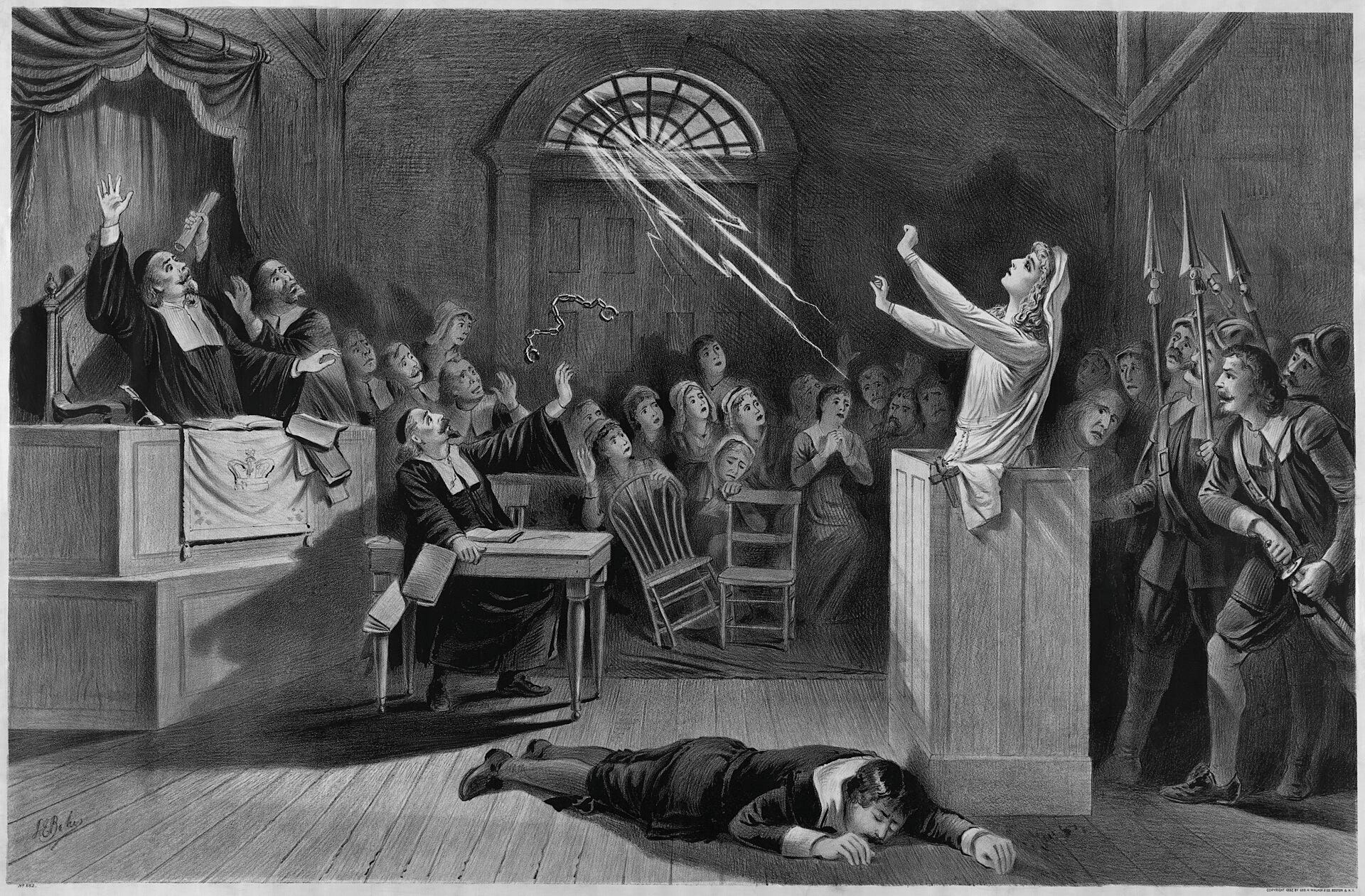
By midsummer, Salem was a stage crowded with the damned and the righteous, though it was often hard to tell which was witch. The afflicted girls convulsed on cue, magistrates scribbled, Parris thundered about invisible armies. Hanging days were treated like sermons — with better attendance.
William Stoughton, chief justice and prosecutor of the court, controversially accepted spectral evidence — demonic visions — as evidence of the accused witches guilt. Claims that accused witches spirits were tormenting people were accepted as fact in the court of law.
Stoughton was more than a colonial judge; he was a major landowner and shrewd land baron who leveraged his legal and political positions to amass wealth and influence for himself and his friends. He had acquired significant swaths of land from tribal parties, and was connected to and a member of the political elite — as were the Porters, but in the trials Stoughton was aligned with the actions of the Parris/Putnam faction. The first Governor of Massachusetts appointed him chief justice of the colonial courts, a position he held for the rest of his life. Stoughton also served as lieutenant governor, appointed in 1692, and acting governor for 6 years until 1699.
Serving as both judge and prosecutor, Stoughton was particularly influential in the trials. In the case of Rebecca Nurse — a 71-year-old woman of good standing in the community and the church — the jury initially found her not guilty, but was ordered back into deliberations by Judge Stoughton, after which she was convicted and hanged.
When all was said and done, unlike many of the other judges involved, Stoughten never admitted error or expressed regret for his role in the Salem Witch Trials.
When the accusations began, they didn’t fall randomly. They fell along fault lines of property and politics. Those who stood against the Putnam faction — those with good land, independent means, or inconvenient opinions — were the ones most often branded as servants of Satan, typically allies of the Porter family.
Giles Corey — famously killed by being pressed rather than hanged — refused to enter a plea, which meant that the court could not proceed with his trial, which meant his property could not be legally seized by the fledgling Massachusetts government. He was pressed to death by heavy stones over the course of three days in an attempt to force a plea. By dying without a conviction, he ensured that his land was passed on to his heirs rather than being sold off to the highest bidder — or rather, the party with the most connections in the highest places.
Giles Corey’s famous last words were reportedly, “More weight.”
Even the records (the few that weren’t “lost” or destroyed) tell on themselves: many of the accused owned valuable tracts near the Putnams’ land holdings. Others were known for resisting church taxes or for opposing Reverend Parris.
The end result?
Families destroyed, estates frozen, and property quietly reassigned.
Through it all, the Putnams’ holdings expanded quietly, as frightened neighbors sold land below value or fled entirely. The Porters, discreetly, bought some of what the Putnams could not claim outright.
Act IV: Witchcraft — Real or Imagined?
So was there any real witchcraft in Salem?
It depends on how you look at it, and what your definition of “witchcraft” is.
The trials moved at a fever pitch, without logic, using confession to fuel the flames, and hysteria as proof. Tituba, the enslaved woman who lived with the Parris’s, confessed under duress to serving the Devil, having made a “witch cake” reportedly at the behest of Mary Sibley in order to determine who was tormenting Betty Parris and Abigail Williams.
A witch cake was a type of folk magic remedy used to identify witches. It was made by mixing rye meal with the urine of someone afflicted by witchcraft (i.e., one of the “bewitched” girls), baking the mixture into a cake, and feeding the cake to a dog, specifically the witch’s “familiar.” It was believed that the dog would react in a way that would reveal the witch responsible. This practice came from English folk traditions. Ironically, while the intent was to identify witches, the use of folk magic like this was considered itself a form of witchcraft by Puritan standards.
But Tituba’s story grew extravagant, including flying beasts, shadow books, black-cloaked men, giving the court exactly the spectacle it craved. Tituba’s confession of seeing dark figures and strange beasts could have actual occult roots in Caribbean spiritual traditions, or have been pure invention under duress. She was spared, while those who protested innocence were hanged.
And there were other bits of folk magic alive in Massachusetts — love charms, divining rituals, protective circles, and other practices that certainly would have been considered demonic in Puritan New England.
The Devil was almost certainly present in Salem — whether directly or through demonic influence in the sinful actions of many of those involved.
But it didn’t really matter whether the Devil went down to Salem or not.
He was useful either way.
The Ergot Theory
Mass hysteria. Folk magic. Land grabs.
And then there’s the moldy rye.
It was, by all accounts, a miserable spring. The winter of 1691 had lingered too long, and the fields of Salem Village lay sodden and cold when the rye began to sprout. It’s here that a modern scientific curiosity slips into the narrative: the Ergot Theory — a postscript that would not surface until centuries later, but one that offers a distinctly chemical explanation for all that hysteria.
Ergot is a parasitic fungus that grows on damp rye and produces alkaloids strikingly similar to LSD. When ground into flour and baked into bread, as was common in the Puritan diet, it can cause an array of symptoms that sound suspiciously like the “bewitchments” recorded in Parris’ journal: hallucinations, convulsions, tingling limbs, uncontrollable fits of laughter or terror, and a creeping paranoia that one’s soul was under siege. To the 17th-century mind, there was no vocabulary for neurology or toxicology, only demonic influence.
Some historians argued that the girls’ strange afflictions — their trembling, their visions, their shrieks of invisible tormentors — may have been the product of a natural hallucinogen coursing through their daily bread. Herbalists of the time occasionally recognized ergotism, calling it “St. Anthony’s Fire,” and noted its use in old European midwifery practices. But to the Puritans, that too smacked of witchcraft.
But the ergot theory doesn’t fully hold up, and cannot account for the totality of what happened in Salem. The afflicted and the accused lived miles apart, their grain likely milled separately, and very rarely was an entire household affected, with just one or two members afflicted. The symptoms did not always align neatly with poisoning, and, curiously, the fits came and went with theatrical timing that suggested something more than biochemistry.
If true, however, it would mean that the girls genuinely believed they were cursed, their convulsions no act at all — an accident of climate and ignorance that spiraled into mass death.
Gender, Power, and Patriarchy
Of course, we’d be remiss not to mention the patriarchy. It’s the lens through which every modern retelling of Salem must squint: men subjugating women, punishing them for being loud, single, opinionated, or inconveniently alive. And yes, there’s plenty of truth there. Nearly 78 percent of those accused were women, most of them older, widowed, or otherwise on the margins of Puritan society. These were women who owned land without husbands, who gossiped too freely, who delivered babies or herbs using practices that bordered on, or were outright, occult.
But — was it really about the patriarchy, or is that simply what modern retellings want us to think it’s about?
Men subjugating women — instead of the actual presence of witchcraft, used as a cover for monopolistic land grabs hundreds of years before the invention of the board game. In a town where a man’s worth was measured in acres, the accusation of witchcraft could be a remarkably effective real estate strategy. Once convicted, an accused witch’s property could be confiscated or sold off — often to those conveniently aligned with the accusers.
The Puritan obsession with female obedience certainly provided the language for the accusations. Ministers like Parris thundered from the pulpit about Eve’s original sin and the Devil’s preference for the feminine vessel. But beneath that theology lay something older and cruder: the fear of women who could inherit their husband’s property and refuse to sell.
Thou shalt not suffer a witch to live.
Exodus 22:18
The Enduring Power of Controlling the Narrative
And yet, perhaps the simplest explanation is the most disquieting. Maybe, just maybe, they really were dabbling in something demonic. Puritan Massachusetts was crawling with herbalists, seers, and midwives carrying Old World knowledge passed down from generations before the Church had names for it. If even a fraction of it brushed up against the occult, it might explain why the hysteria burned so hot, and why, centuries later, some of their descendants have emerged curiously wealthy, influential, and well-connected.
The Nurse family line runs into Massachusetts politics. The Putnams seeded industrial fortune. The Proctors into New England’s merchant elite. And through various colonial marriages and migrations, descendants of the “bewitched” and the “accusers” alike can be found among America’s dynasties — the bankers, the governors, Hollywood elite and the Ivy League trustees. Perhaps there’s no curse at all, only a bloodline that learned early how to survive a public scandal.
After all, Salem didn’t just burn witches. It birthed a uniquely American tradition: moral panic and mass formation psychosis as a business model.
A few of the celebrities with connections to the witch trials:
Nathaniel Hawthorne: Descendent of John Hathorne, a leading judge
Walt Disney: Descendant of George Burroughs, a minister hanged for witchcraft (George Burroughs is also related to 21 presidents)
Sarah Jessica Parker: 10th great-granddaughter of accused witch Esther Elwell (escaped trial)
Vincent Price: Seventh great-grandson of accused witch Rebecca Nurse (hanged)
Mitt Romney: Eighth great-grandson of Rebecca Nurse
Benedict Cumberbatch: Descendant of Rebecca Nurse
Christopher Reeve: Descendant of Rebecca Nurse
Amy Grant: Descendant of Rebecca Nurse
Lucille Ball: Descendant of accused witch Rachel Vinson (acquitted)
Richard Gere: Descendant of Rachel Vinson
Ernest Hemingway: Distant cousin of accused witch Samuel Wardwell (hanged)
Humphrey Bogart: Descendant of accused witch Ann Pudeator (hanged)
Claire Danes: Descendant of accused witch Margaret Scott (hanged)
Kyra Sedgwick: Distant relationship to William Stoughton, the chief judge
Ray Bradbury: Descendent of accused witch Mary Bradbury (avoided sentencing)
Linda Hamilton: Descendant of Mary Bradbury
Joseph Smith (founder of Mormonism): Great-great-grandson of Samuel Smith, who testified against a woman who was executed
Many more famous people related to those involved in the Salem Witch Trial can be found here, at famouskin.com.
Act V: The Sanitized Aftermath
By autumn, the fever cooled. Ministers in Boston began to whisper that perhaps Satan had duped the accusers as easily as the accused. The whole ordeal lasted just over a year, but by the time Governor Phips put a stop to the trials in 1693, twenty-five people were dead, and nearly two hundred accused.
Within a few years, most of the documents, testimonies, and property disputes quietly disappeared.
Parris lost his pulpit within five years, hounded from the village he had once ruled.
The Putnams retreated behind their fences, their influence curdled into suspicion.
The Porters emerged victorious. Their descendants would marry into respectable lines, their fortunes untroubled by ghosts.
The new story became one of moral overreach and communal repentance. Ministers preached lessons about hysteria, not greed. The courts eventually declared the victims innocent — but no one returned their land.
And so the official narrative hardened into a morality play about the dangers of superstition.
History, as usual, favored the wealthy victors.
Epilogue
The Salem Witch Trials endure because they are a useful guide to those in power: people don’t need proof to destroy each other, just a story that feels true.
In 1692, that story was witches and devils.
Today, it might be something else entirely — but the machinery’s the same: fear, accusation, moral certainty, and the quiet profit of those who manage the narrative.
The “witches” of Salem were never really the enemy. The enemy was the system that found moral justification for theft, control, and the destruction of our perceived rivals.
Centuries later, tourists stroll through Salem buying plastic broomsticks and “I Survived the Witch Trials” t-shirts.
The town makes a tidy living off its ghosts.
Of course, my sister just returned from visiting Salem this weekend and I am curious to get her feedback on your article. Love that you both wrote it together! I’ve always been under the impression that it was the patriarch taking down women with a mix of the occult. But the curious fact is the landowning that really drives this home. Maybe Rebecca was the sacrifice?
This was fascinating! I never knew all these details either. So fun you wrote it together and it’s excellent! Entertaining and with may turns of phrase that I thoroughly enjoyed. Too many to list but I particularly loved “more interested in profits than prophets”. What can I say, I love a good pun. Very interested in a part II!