


When the Science Settles
For most of my life, I assumed the question of Noah’s Flood had been decisively settled. A story relegated to children’s books and Sunday school murals, a metaphor used to simplify our understanding of human origins — and maybe a localized flood, at best.
But as I continued to read Genesis literally, I realized something that radically shifted my entire worldview: the text itself does not present the Flood as poetry, parable, or mythic allegory. It presents it as history. Names, ages, dates — specific measurements followed by specific durations followed by very detailed genealogical lines that align to specific identifiable points in the historical record. The narrative of Genesis — from the very beginning, not just after chapter 11 — moves with the cadence of specific chronology, not symbolism.
That is how I found myself asking a question I once considered unthinkable:
Did Noah’s flood really happen? Was the entire world underwater, all at once?
The Biblical account of a global flood is routinely treated as a symbolic or moral story. But read plainly, it makes concrete claims about Earth’s history:
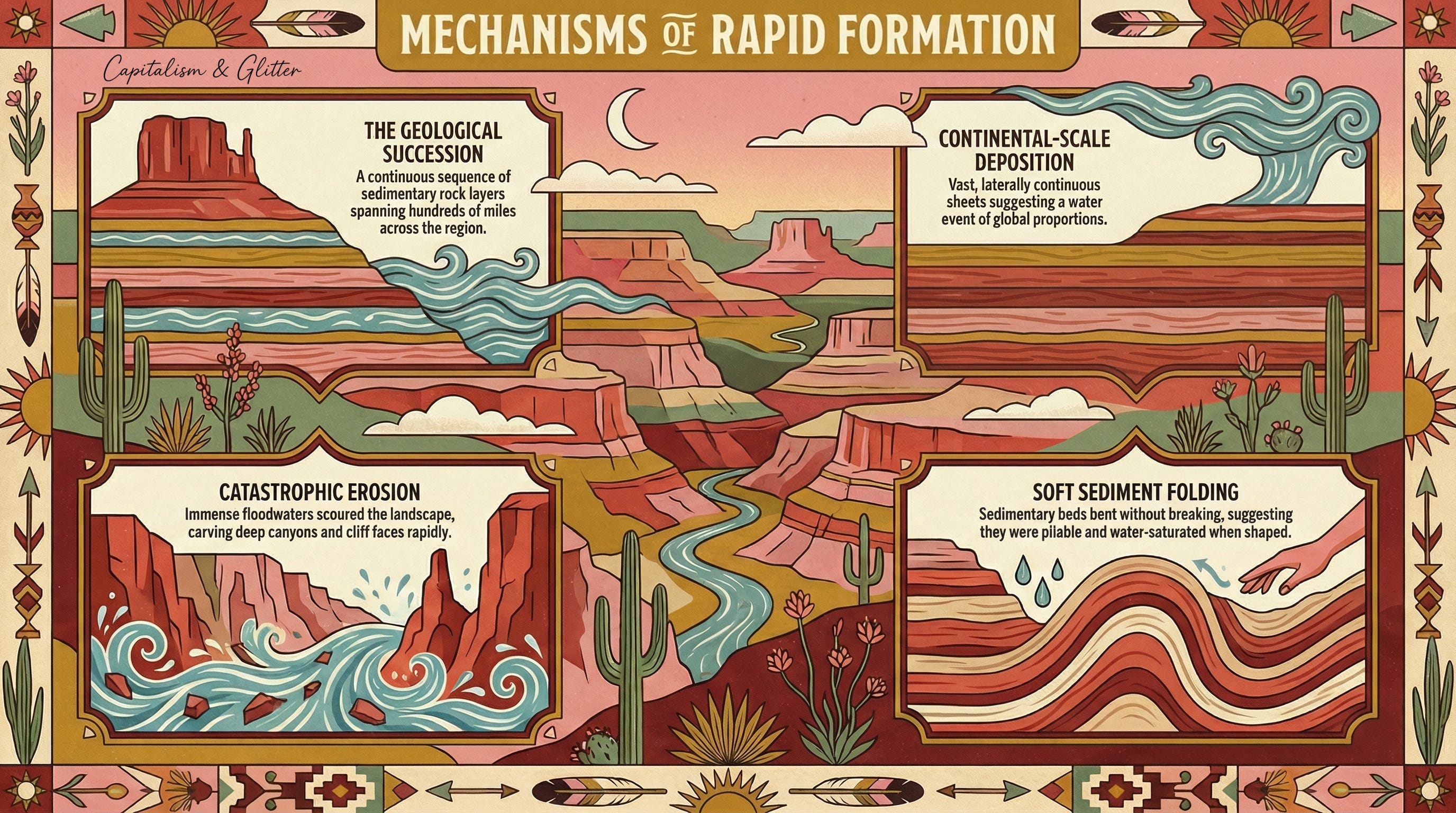
A catastrophic inundation of all the land
Massive erosion of pre-existing terrain
Rapid burial of organisms
Enormous sediment transport
A short, intense timescale
If such an event occurred, it would not leave subtle traces. It would leave distinctive geological evidence.
The question is not just whether the Flood fits modern geological theory, the question is whether the actual rock record, when examined carefully, shows evidence of it.
Increasingly, the answer appears to be yes.
Marine fossils found at the top of Mount Everest.
Flood “myth” origin stories that repeat in hundreds if not thousands of cultures on every continent the world over.
Fossilized trees that extend through multiple rock layers that are supposedly thousands or millions of years old — indicating the layers formed rapidly before the trees decayed.
Not only does modern science not categorically exclude the global flood story, at minimum, modern geology actually agrees with the Biblical account that every continent was once at the bottom of the sea.
Modern science and ancient Biblical narratives agree that massive water-driven processes shaped Earth’s surface. They just don’t agree on how long ago those processes occurred, how many separate events were involved, and whether they could have been part of a single, global catastrophe.
When the floodwaters recede, the question may not be whether the Biblical story survives scientific scrutiny—but whether our assumptions about Earth’s past need reexamining.

As I continued to read Genesis literally, it was beginning to feel less like ancient history and more like the ultimate throwback trend. In a world that worships science, believing the earth is young and the fossil record is flawed is like wearing stilettos to walk down a cobblestone street.
Is skepticism the new black? We claim to be enlightened when we chant “trust the science” — but have we simply traded one kind of orthodoxy for another?
As I closed my Bible and glanced at my reflection, I couldn’t help but wonder — was Ken Ham right?
Capitalism & Glitter is a reader-supported publication.
If you’d like to support us and receive Biblical deep dives like this one directly in your inbox, please consider a paid subscription. Paid subscribers receive:
New! The Edit weekly newsletter, and access to all community chats
Full-length weekly Biblical and archaeological deep dives
The entire archive of content on health and wellness, secret societies, and more (50+ articles)
Discounts on merch and upcoming ebooks