

The Timeless Warning Written in Leviticus
What the Bible teaches us about assessing, addressing, and remediating mold


Disclosure: This article is sponsored by Micro Balance Health Products. The perspectives shared here reflect our own research, experience, and interpretation of Biblical and environmental health principles. We only partner with brands whose products align with a prevention-focused, non-toxic approach to environmental health.
Having gone through a mold remediation and dealing with the effects of it both in my house and in my body, I’ve learned the hard way that most modern contractors and doctors are unfortunately under-informed about mold — both how it affects modern houses, and how it affects the human body.
Modern culture treats mold as a simple nuisance.
A mere cosmetic issue.
Something to spray, paint over, or just wipe away.
The Bible did not.
Long before air sampling, spore counts, or mycotoxin panels, the Bible treated mold as a serious environmental threat that required inspection, isolation, material removal, and, when necessary, total demolition.
What’s remarkable is not simply that mold appears in the Biblical text, but how seriously it is treated, and how closely those ancient protocols resemble what modern environmental health is slowly rediscovering as best practices.
Capitalism & Glitter is a reader-supported publication. This article has been made available for free thanks to a brand partner.
If you’d like to support us, please consider a paid subscription. Paid subscribers receive:
New! The Edit weekly newsletter, and access to all community chats
Full-length weekly cultural, Biblical, and archaeological deep dives
The entire archive of content on health and wellness, secret societies, and more (50+ articles)
Discounts on merch and upcoming ebooks
The Forgotten Lessons of Leviticus
Unlike those under-informed contractors, the Bible actually tells us exactly how to deal with mold in a house.
Leviticus contains the most direct instructions outlining laws around mold. Chapters 13 and 14 in particular contain detailed instructions addressing contamination in garments and dwellings, what the Hebrew text describes as a spreading affliction within materials themselves.
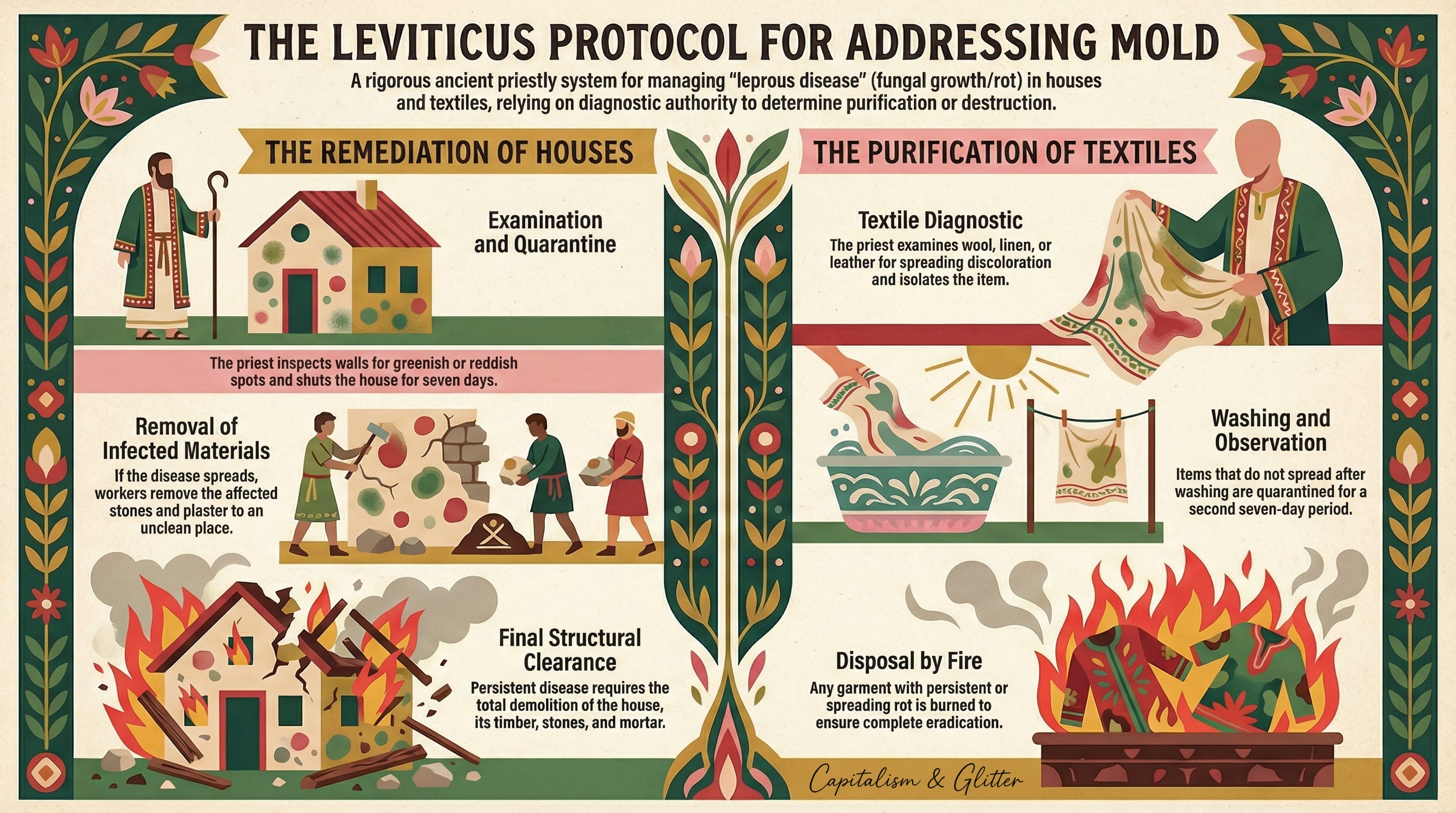
As detailed in Leviticus 14:33-48, the Biblical approach on how to address mold is both incredibly specific and highly systematic. Visual inspection, temporary quarantine, observation over time and the removal of affected materials. Not just the removal out of the afflicted house, but out of the village altogether as to not contaminate any other people or structures. If this removal is still not sufficient to remediate the issue, then complete demolition is called for. This applies to both physical structures as well as fabric and clothing.
Laws for Cleansing Houses
The Lord spoke to Moses and Aaron, saying, “When you come into the land of Canaan, which I give you for a possession, and I put a case of leprous disease in a house in the land of your possession, then he who owns the house shall come and tell the priest, ‘There seems to me to be some case of disease in my house.’ Then the priest shall command that they empty the house before the priest goes to examine the disease, lest all that is in the house be declared unclean. And afterward the priest shall go in to see the house. And he shall examine the disease. And if the disease is in the walls of the house with greenish or reddish spots, and if it appears to be deeper than the surface, then the priest shall go out of the house to the door of the house and shut up the house seven days. And the priest shall come again on the seventh day, and look. If the disease has spread in the walls of the house, then the priest shall command that they take out the stones in which is the disease and throw them into an unclean place outside the city. And he shall have the inside of the house scraped all around, and the plaster that they scrape off they shall pour out in an unclean place outside the city. Then they shall take other stones and put them in the place of those stones, and he shall take other plaster and plaster the house.
If the disease breaks out again in the house, after he has taken out the stones and scraped the house and plastered it, then the priest shall go and look. And if the disease has spread in the house, it is a persistent leprous disease in the house; it is unclean. And he shall break down the house, its stones and timber and all the plaster of the house, and he shall carry them out of the city to an unclean place. Moreover, whoever enters the house while it is shut up shall be unclean until the evening, and whoever sleeps in the house shall wash his clothes, and whoever eats in the house shall wash his clothes.
But if the priest comes and looks, and if the disease has not spread in the house after the house was plastered, then the priest shall pronounce the house clean, for the disease is healed.
— Leviticus 14:33–48 ESV
It then goes on to discuss cleansing the house by killing a bird over fresh water and dipping another bird, wood, yarn and hyssop in the blood of the first bird to sprinkle around the house seven times before releasing the live bird into the countryside to make atonement for the house — but that part seems less relevant to modern day protocols. Although, it is interesting to note that hyssop is an antifungal.
In addition to detailing mold remediation protocols, the Bible also acknowledges that mold illness is very real. And if you refer to the passage above, you will notice that it calls mold illness leprosy.
The Hebrew term that is often translated as “leprosy” or “leprous disease” is tzaraʿat. Tzaraʿat is used regularly throughout the Bible to mean mold, mildew, illness, and unclean (not merely a spiritual uncleanliness but a physical illness). Embedded within the original Hebrew is a deeper understanding of the translation: disease caused by mold (fungus).
Simply put, tzaraʿat is a fungal infection that spreads both in people and homes.
Leprosy in this context is distinctly different from the disease we know as leprosy today (which is caused by bacteria, rather than fungus).
When there is a case of leprous disease in a garment, whether a woolen or a linen garment, in warp or woof of linen or wool, or in a skin or in anything made of skin, if the disease is greenish or reddish in the garment, or in the skin or in the warp or the woof or in any article made of skin, it is a case of leprous disease, and it shall be shown to the priest. And the priest shall examine the disease and shut up that which has the disease for seven days. Then he shall examine the disease on the seventh day. If the disease has spread in the garment, in the warp or the woof, or in the skin, whatever be the use of the skin, the disease is a persistent leprous disease; it is unclean. And he shall burn the garment, or the warp or the woof, the wool or the linen, or any article made of skin that is diseased, for it is a persistent leprous disease. It shall be burned in the fire.
— Leviticus 13:47-52 ESV
Leviticus isn’t the only book of the Bible that deals with mold and describes leprosy as a fungal infection. For example, Numbers 12:10 recounts Miriam’s affliction with leprosy — which rendered her “white as snow,” a common symptom of a fungal infection called “tinea versicolor.”
A Biblical Approach to Mold Remediation
This systematic and sequential approach to addressing mold is one of the clearest contrasts with the typical modern practice of brushing it under the rug:
Removal from exposure
Quarantine the house and don’t allow anyone inside
Seal the structure
Allow 7 days to reveal whether the contamination was active or spreading
Only after this period were repairs attempted
If the problem remained, the response escalated to removal and replacement of the affected objects, plaster, and structure — and if it still continued, well that called for complete destruction.
There was no sweeping this under the rug.
No insistence that visible damage was harmless.
No prioritization of property value over health.
Ancient Israel operated on a principle we seem to have entirely forgotten in the west: some environments are not neutral, and cannot be made safe by denial.
For those who have experienced mold exposure and then struggled to have their symptoms taken seriously, the Biblical perspective is quite reassuring. Modern responses often default to minimization—treating environmental illness as stress, anxiety, or coincidence—rather than investigating the space people live in to uncover the true root cause of symptoms.
Scripture assumes the opposite: that spaces can harm people, and that the community (under the authority and guidance of the priest) bears responsibility for addressing it.
Harm That Accumulates Slowly
Mold is dangerous precisely because it works slowly.
Certain molds can produce mycotoxins and volatile compounds that contribute to inflammatory, neurological, and immune disruption—often long after the initial exposure. The delay obscures cause and effect, making the illness easier to dismiss.
Interestingly, the passages in Leviticus identify red and green molds as especially problematic — which modern fungal and bacterial science confirms.
Stachybotrys — also known as black mold — actually appears in a color ranging from dark green to black. Other “green” molds are associated with Aspergillus, Penicillium, and Cladosporium which are among the most common indoor molds found in damp buildings today.
“Red” molds are associated with Fusarium mold, Rhodotorula yeast, and Serratia marcescens (a bacteria, not mold). Ancient observers would not have distinguished mold vs. bacteria vs. yeast—they simply described unusual colored growth spreading in damp materials.
These molds (and bacterial) growths produce allergens, irritants, and in some cases mycotoxins. The “red and green mold” in biblical language most likely corresponds broadly to visible microbial growth in water-damaged buildings and clothing —what today we’d call indoor mold contamination, damp building syndrome, and microbial growth from chronic moisture.
A Modern Approach Supported by Micro Balance Health Products
Like many other families, our family has, unfortunately, had our fair share of mold experiences. We have lived through mold exposures in two homes, one of which we remediated. After remediation, we suffered yet another water leak in the same place when our roof patch failed.
After experiencing these issues in our own home, and the associated adverse health effects, we learned how quickly moisture issues escalate — and how inadequate surface-level cleanup can be.
This same prevention-first mindset that is conveyed in Leviticus is increasingly reflected in modern environmental health approaches and in companies like Micro Balance Health Products that prioritize non-toxic, exposure-aware solutions, rather than aggressive chemical masking.
As part of our remediation process, we relied on the following products from the EC3 line of Micro Balance Health Products specifically formulated to address mold spores:
Enzyme Cleaner and Wipes — used before, during, and after remediation to mitigate the spread of any mold spores through the house as we addressed removing and replacing the damaged building materials. We still use these cleaners regularly to mitigate any mold spores in our house, especially in wet areas of the kitchen and bathrooms. We also keep a container of these wipes in our car.
Air Purification Candles — used before, during, and after remediation to mitigate the spread of any mold spores through the house. I still use these candles regularly; the beeswax are my fave (and especially biblical).
Laundry Additive — used before, during, and after remediation to remove any mold spores from our clothes as we lived through remediation. We still use this regularly and it’s one of my favorite Micro Balance Health Products.
Mold Test Kits — incredibly helpful before and after remediation to help us understand the approximate level of mold spores in the air and whether we had sufficiently addressed the issue.
Head-to-Toe Cleanser — a newly released product, this shampoo and body wash helps rinse away mold, mycotoxins, and environmental contaminants.
These products helped mitigate exposure and support a cleaner living space while addressing the underlying moisture issue, rather than assuming everything was “fine” once things looked dry. We weren’t looking for a quick fix, we were focused on preventing water damage and preserving the health of our family — especially our young children.
Unlike a lot of modern “quick fix” approaches to mold, the detailed framework on how to address mold concerns outlined in the Bible follows a clear pattern — observe before dismissing, intervene before normalizing, and escalate when remediation fails.
The Bible outlines an appropriate response to mold that neither ignores nor overreacts.
Because above all, we are reminded be not afraid.
Sponsor Note: This piece was written in partnership with Micro Balance Health Products, whose non-toxic, mold-focused products we’ve used as part of our own efforts to reduce environmental exposure. As always, sponsorship does not influence our conclusions, only supports the continued creation of this work. To support us directly, please shop Micro Balance Health Products and use our code GLITTER for 15% off.
I love this topic! I went through a massive stachybotrys situation in 2020 and went down all the mold rabbit holes. While researching, I learned mold was in the Bible and an illustration of sin. I was in the new age at the time, but learning that compelled me to buy my first Bible. It was one of many threads that pulled me in the direction of Christianity. I had to get rid of everything I owned, which included all of my occult books and other witchy things. Mold is awful, so it’s pretty awesome to see how seriously God takes it.