


Welcome to Capitalism & Glitter’s Good Book Club!
I am so excited to announce our 2026 Bible Study. I am currently calling it the ‘Good Book Club’ but this name may evolve. I am also considering calling it GodTok — like MomTok, get it? Then when we’re slogging through Leviticus I can be like, “Will GodTok survive this?” and we’ll all laugh. Yeah, you get it.
Who is this for?
Anyone who wants to learn more about the Bible!
Anyone who has drifted from faith in God to New Age leanings and back again, anyone who has gone down every rabbit hole and found that all roads lead to Scripture, anyone who has ever set out to debunk Christianity and found themselves totally surprised by a resulting call to faith.
Anyone who wants to draw nearer to Jesus.
And anyone who’s not yet sure where they are!
This is open to people at all points of their faith walk. Whether this is your first time reading through the Bible or your 10th, whether you’re able to commit to every reading or just want to join along for the Substack ride, I hope this group will bring interesting discussion points for all of us to deepen our understanding of world history, human nature, and the spiritual world we find ourselves living in — as well as providing the scaffolding of a structured book club to accomplish actually reading the Bible in a year.
How to Join
Joining is easy — simply subscribe to the Capitalism & Glitter Substack!
All Bible Study specific content will be available for free, however there are certain articles of mine that relate to various topics that already have been or will be published behind a paywall (though even these articles typically have a significant free introductory section). Feel free to join and participate as either a free or paid subscriber by entering your email below.
How to Opt-Out
If you are already signed up as a subscriber, but you do not want to get the Bible Study emails and articles (approximately one email/article a week), you can opt-out of this section of my Substack using the following steps:
Go to your Substack profile (top right corner) and click the dropdown arrow
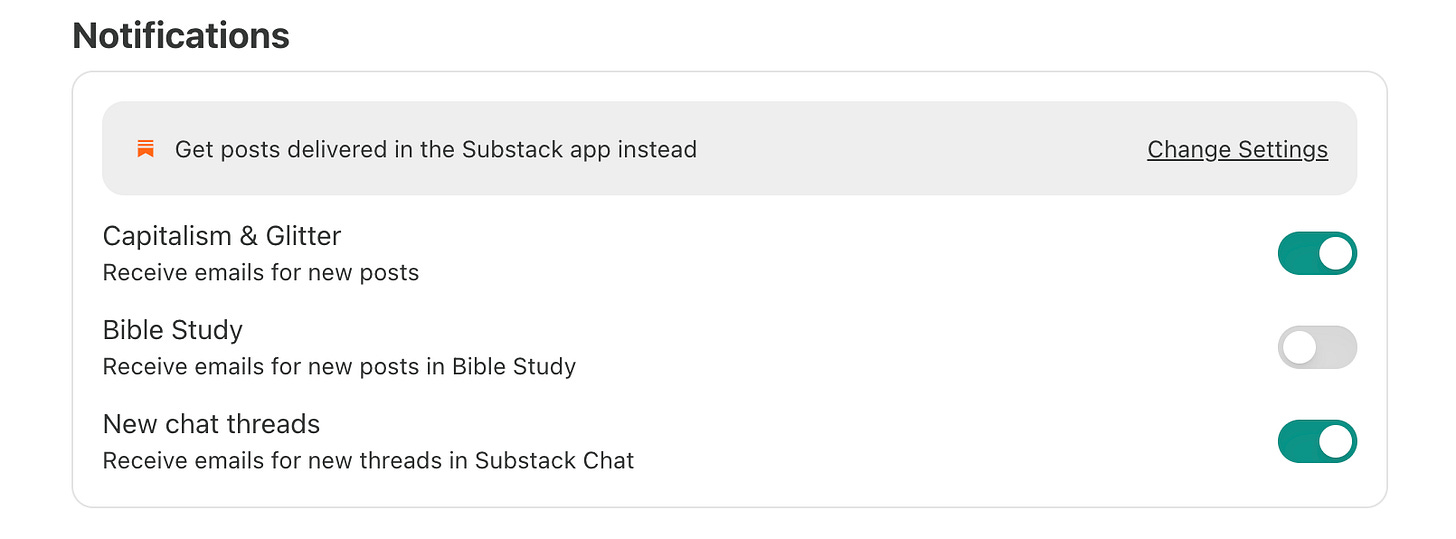
Click on ‘Manage Subscription’ and find the ‘Notifications’ section — it should look something like the screenshot below
Switch off the toggle next to “Bible Study” but leave the other toggles on, like so:
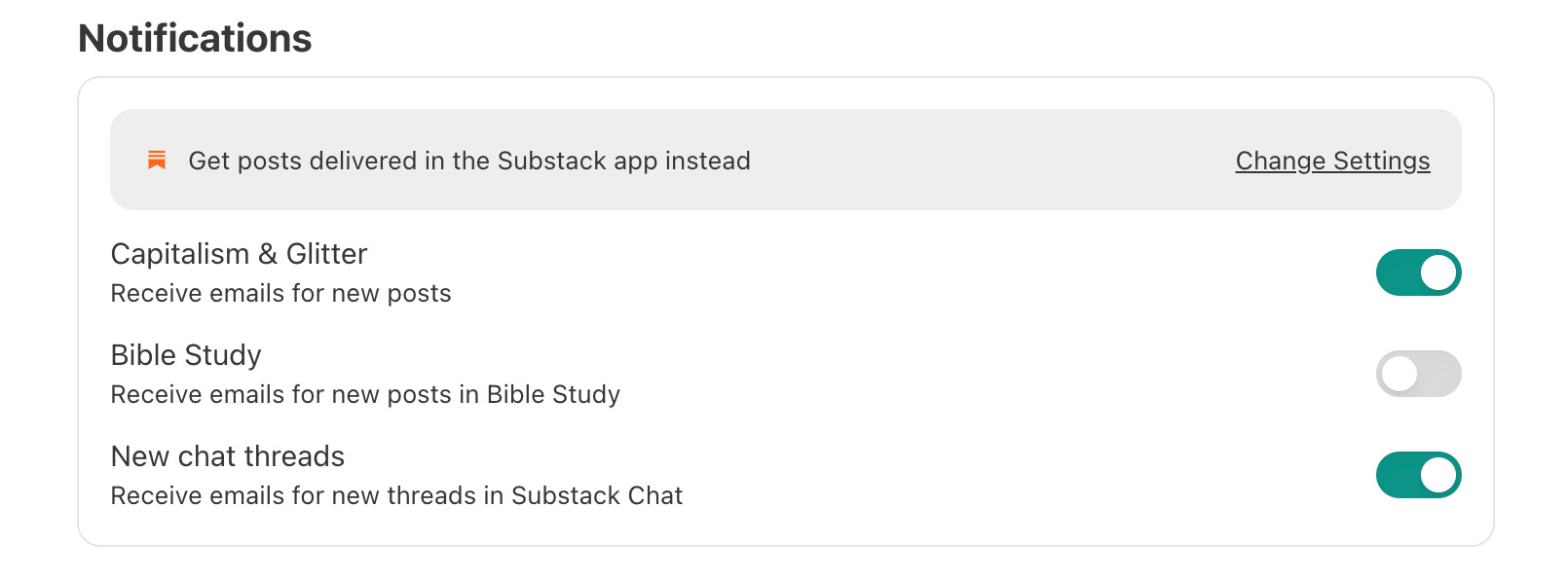
That’s it! You can opt in or out of the Good Book Club at any time.
Where Weekly Discussions Will Be Held
I am planning to send out a weekly post/email each Sunday with the readings for the week. You can follow along with daily readings, which will take approximately 15-20 minutes a day, or roughly 1.5-2 hours a week. You can spread out the daily readings, do them all in one sitting, or break them up however you want over the week.
If you are unable to do the readings one week, you can simply catch up the next week, or follow along with the discussion in the comments and chat. I understand life happens and this is a commitment that not everyone will be able to keep up with. While I, of course, hope to cultivate a dedicated book club of consistently engaged weekly readers — you can jump in or out at any time.
We can then share thoughts on the readings in the comments on that post and in Substack chat. I am looking to you guys to help me understand which topics you want to focus on and help me shape the discussion — so please feel free to share your thoughts, questions, and comments.
The Bible & The Plan
“Which Bible are we using?” has been the number one question since I announced I was planning to do a Bible in a Year Book Club.
For those who are brand new to the Bible — there are multiple versions of the Bible used by the various Christian denominations. And when I say “versions,” I don’t mean that there are wholly different stories — there are simply some versions that contain 10-20% more books than others.
The Bible is not a single book written all at once, it is nearly 100 books written across 1500 years by about 40 different authors. Different Christian traditions — Protestant (66), Catholic (73), and Orthodox (76-88) — include a different numbers of books depending on what is most relevant to their theology. But, all of these books (and more!) are relevant to Christian history.
You can read and learn more on this in my second Bible Study article titled History of the Bible, which will be published later this week.
Our Bible in a Year Plan
For the sake of completeness, and in the interest of exploring what is interesting, we are going to be reading 75 books of the Bible — the 73 included in the Catholic and Orthodox Bibles, plus the Book of Enoch and the Book of Jubilees, both of which are contained in the Ethiopian Orthodox Bible. I am potentially open to being talked into adding more books if there is something of particular interest, so please let me know in the comments if there are other books you think are important or relevant for us to cover.
In order to best understand the history and context of the Bible, we will be reading the books chronologically. We will largely be following the Ascension Bible in a Year plan covered by Father Mike Schmitz, because it incorporates all 73 books chronologically but it also has “Messianic checkpoints” where you read one of the four Gospels each quarter, so that it doesn’t take 9 months to get to the New Testament. This also allows us to see the foreshadowing of Jesus throughout the Old Testament.
I am also referencing the Blue Letter Bible Chronological Plan as we go through the year and structure the readings. This is very similar to the Ascension Plan, although the Blue Letter Plan covers just one book at a time, and is strictly in chronological order so does not get to the New Testament until October.
As well, I just learned that the guys from Blurry Creatures and Dr. Joel Muddamalle are launching their own Bible in a Year project, called Stranger Theology, and I will be following along to see how that evolves and if their structure and content is something we want to incorporate as well. They will be focusing on the “blurry” content in the Bible that often gets left out of other theological studies, so it should be interesting (though it looks like you do have to pay to join and read most of their Bible Study articles). UPDATE — their bible in a year plan pdf can be found here.
There are just so many good and useful resources. What a great time to be alive and reading the Bible!
Bibles & Other Resources
The second most common question I have been getting since announcing this Bible study is, “Which Bible should I get?”
If you have followed me for a while, you have heard me say the following: The best Bible is the one you can understand and will actually read.
All 75 books we will be reading are available for free on the Bible app and with accessing pdfs online, so we will each need to decide what we want to purchase. All Bibles contain at least 66 of the 75 books we are going to read (at least, they should). The Protestant Bible has 66 books, the Catholic Bible has 73 books, and the Orthodox Bibles vary, with 76 in Greek Orthodox and as many as 81-88 in Ethiopian Orthodox. You can get or use whatever Bible you are most comfortable with, or is closest to your faith, and supplement with other resources as needed.
Your reading list will be to piece together the following:
A Bible (likely containing 66-73 books, all available for free in the Bible App)
the Apocrypha/Deuterocanon of the 7 books not included in the 66-book Protestant Bible, if needed
The Book of Enoch (free pdf available online)
The Book of Jubilees (free pdf available online)
Translations
Not only are there multiple versions of the Bible for various denominations, there are also multiple translations of the original Hebrew, Greek, and Aramaic text, ranging from word-for-word translations (known as formal equivalence) to thought-for-thought translations (dynamic equivalence) which can be easier to read, especially for beginners. There are also paraphrased translations, and those are the least precise and accurate to the original text.
Below are some of the most popular translations:
NLT (New Living Translation) — an excellent choice for a beginner, this uses modern language, dynamic equivalence, and is the easiest to read and understand. The standard is a Protestant (66 book) translation, and the Catholic version is NLTCE (New Living Translation Catholic Edition), which contains 73 books including the apocrypha (which is the protestant name for the 7 books not in their Bibles).
NIV (New International Version) — this is also a great choice for a beginner and is the most widely read English Bible and it balances a more modern translation for readability for accuracy. Protestant (66 book) translation only.
CSB (Christian Standard Bible) - increasing in prominence as an optimal equivalence between formal and dynamic equivalence translations. Protestant (66 book) translation only.
ESV (English Standard Version) — this is the closest to the original translation of Greek and Hebrew using a very literal formal translation but modern English. Protestant (66 book) translation only.
NABRE (New American Bible, Revised Edition) — mostly dynamic equivalence with some formal elements, a more readable version of the Catholic Bible containing 73 books.
RSV-2CE (Revised Standard Version, Second Catholic Edition) — more formal translation, a more literally accurate version of the Catholic Bible containing 73 books.
Bible App
First and foremost, I highly recommend that everyone download the YouVersion Bible App. It is free and it contains thousands of versions of the Bible in thousands of languages. This app allows you to cycle through translations to find the one that’s most comfortable for you to read. You can also compare translations to help your understanding. It contains translations for Protestant, Catholic, and Orthodox denominations, so you will have access to nearly all the books we are reading in the palm of your hand (except for Enoch and Jubilees).
If you are a beginner, I recommend flipping through the NLT and NIV versions and determining which one is more readable and understandable to you.

Bible Types
There are a few types of Bibles you can buy — a standard Bible with just the text of the Scriptures, a journaling or wide-margin Bible that has wider pages and space for you to take notes, or a study Bible that includes commentary with explanations, maps, and additional information that can help you understand the Bible.
Below are some of my favorite options for Bibles and other supplemental texts you can buy. Some of these are referral links, and many of them are available in my Amazon Storefront (along with my favorite Bible history chart and a Bible Storybook for Kids). (And don’t you worry, my husband is currently workshopping a reel to make fun of me for sharing affiliate links to Bibles. Hey, I’ve gotta support the free Bible study somehow!)
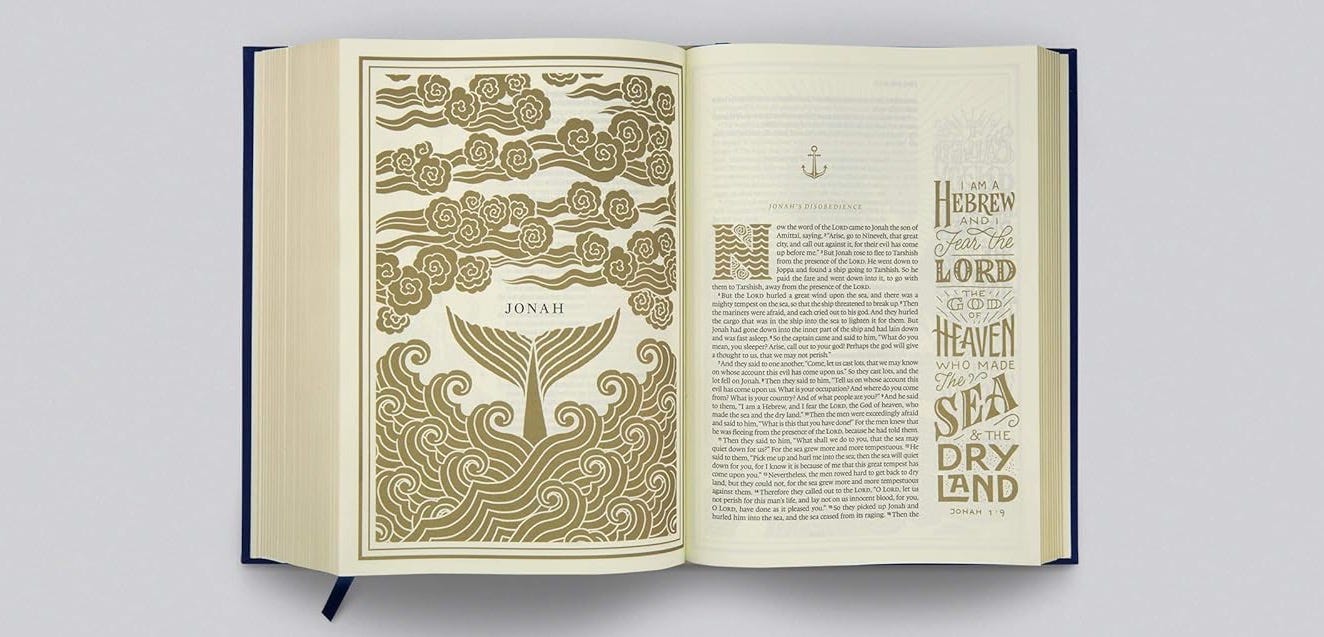
Protestant Bibles (66 Books)
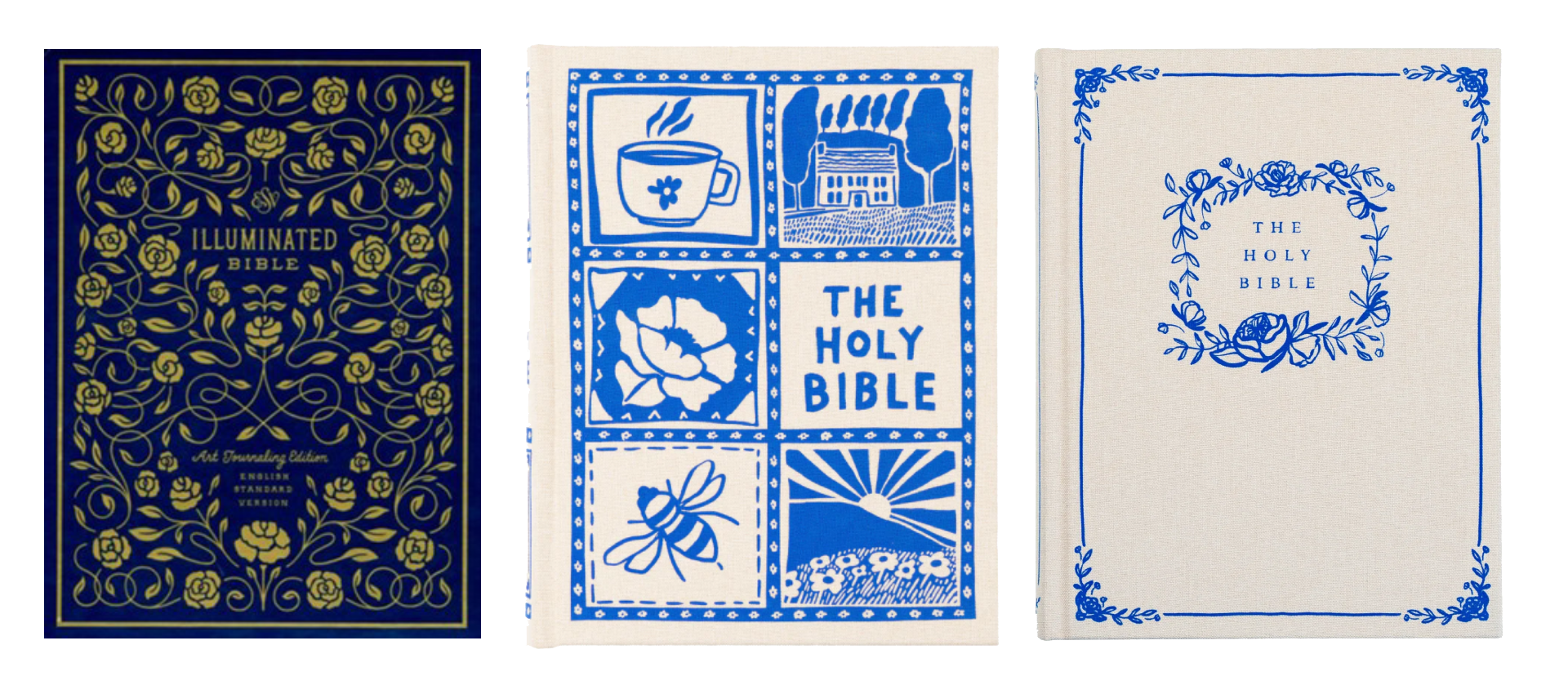
ESV Illuminated Bible, Art Journaling Edition - I have this and I love it, but it’s almost too pretty to open because I’m afraid my kids will mess it up, and it’s definitely too pretty to write in. It also comes in Burgundy and Olive Green.
CSB Notetaking Bible: Oxford Theme (10% off with this link) — Also very pretty, but not too pretty to write in. The cup of coffee on the front feels cozy and inviting.
NLT Notetaking Bible: Adelaide Theme (10% off with this link) — This might be my number one recommendation for someone new to the Bible. It’s the prettiest version of the easiest translation that I’ve seen. I’m debating buying this one or the previous one.
Catholic Bible (73 Books)
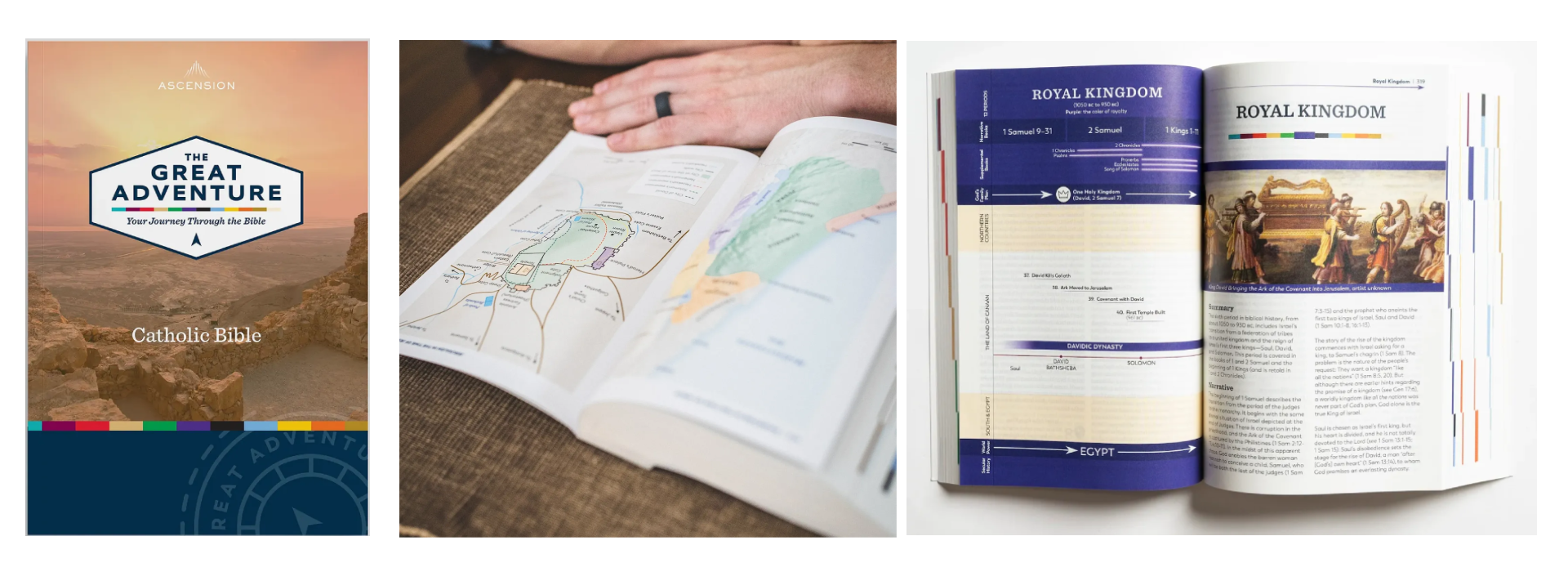
I’m honestly a little disappointed that there aren’t more options for cute aesthetic Catholic Bibles, but I get it because the Catholic Bibles tend to be more solemn and reverent. And I know the aesthetic is not the point of reading the Bible, but as a cradle Catholic I do take great joy in aesthetics. I am, however, very interested in the Great Adventure Study Bible, which incorporates a color-coded timeline and contains charts, maps, and commentary explaining all the historical context. This is also the version used by the Ascension Bible in a Year Plan. There are multiple versions of this, including the standard paperback (pictured here) and a note-taking version. I will likely buy this as well.
The Ignatius Study Bible is also widely regarded, and currently on sale, but I have been advised that it is huge and can be intimidating. But it is chock full of information explaining the historical, cultural, literary, and archaeological background of Scripture.
The Books of Enoch and Jubilees
There are so many versions of the Book of Enoch and Book of Jubilees floating around and it’s hard to determine which ones are legitimate. Everyone looooves a secret hidden book cut from the Bible!
We’ll get into the details of why these books were left out of most Catholic, Orthodox, and Protestant canons, but for now let’s just focus on which versions are the most reliable, and where you can buy or find pdfs of those reliable texts.
First of all, you may see reference to three books of Enoch, with their titles styled as 1 Enoch, 2 Enoch, and 3 Enoch. Only the first one, 1 Enoch, was known to Jesus and the Apostles, is the one referred to in the New Testament, was widely read by church fathers, and is included in the Ethiopian Orthodox Bible. This is the one we will be reading, and we will not read 2 and 3 as they are less historically and canonically relevant and are more akin to fanfic.
The two reliable scholarly translators/translations of both Enoch and Jubilees are:
R. H. Charles – an Irish Anglican theologian and translator from Northern Ireland who translated Jubilees in 1895 and Enoch in 1906 from Ethiopic language (Ge’ez). His work is classic and influential, and still cited, though now dated.
George Nickelsburg & James VanderKam – Modern professors of religion, their work is the most current gold standard of translations of Enoch and Jubilees (published in 2012 and 2020, respectively), as they incorporate contextual evidence found from the Dead Sea Scrolls, discovered in 1947.
Here are two good options to access the Book of Enoch online:
Book of Enoch at Internet Archive (Nickelsburg & VanderKam translation)
Book of Enoch on web (Charles translation)
And two good option to access VanderKam’s version of Jubilees online here:
Options for purchasing the Nickelsburg and VanderKam versions of the Book of Enoch and Book of Jubilees, as well as several of my favorite Bibles and other resources, can be found in my Amazon storefront.
NOTE: If you see a collection of these texts claiming to also have the Book of Jasher, immediately disregard that in its entirety. The real original Book of Jasher has been lost for centuries if not millenia, and the version of Jasher circulating in modern day is a forgery from the Middle Ages. The Book of Jasher was indeed mentioned in the Hebrew Bible but has not been recovered, and anyone claiming to have it now is presenting a relatively recent falsified book that has more recently been promoted by Mormon interests (Joseph Smith always catching strays in my religion articles).
In Summary…
All you need to get started is to join this Substack and download the Bible App. Purchase a Bible you like, if you want. Buy the Books of Enoch and Jubilees if you want, or check out the links to follow along online.
That’s it!
I look forward to reading the Bible with all of you!
I absolutely cannot wait for this. Purchased 5 Bibles today in anticipation 😂😂 Oh and the giant map for our homeschool room! 🤣
Im excited! I’ve only ever been in Protestant Bible studies. I have never read the apocrypha and was ignorant of the history behind them. Did a quick ChatGPT rabbit hole and wow! 🤯