


Week 2, let’s goooo!
Structure of the Good Book Club
I’ve been getting a lot of questions on the structure of The Good Book Club. For the most part, I will be sharing my thoughts on the upcoming week’s readings through these weekly posts. It’s up to you whether you choose to read these posts after doing the readings or before (might be helpful if you’re brand new to the Bible or think it might be boring). My commentary is not intended to be a full summary/overview or a replacement of the readings — my goal is simply to break down some of the meaning and the most interesting or confusing parts.
You can share your thoughts on the week’s readings in the comments on these posts, and we can discuss in the monthly chat. I am also figuring out an end-of-month zoom or live where I will discuss the main thoughts/ideas/theories/lessons from each month.
Other Bible in a Year Plans
This study goes through the Bible chronologically (plus Enoch and Jubilees), so if you are looking for an audio/podcast with daily insight from theologians, you can use the Capitalism & Glitter Good Book Club as a discussion group while going through something more established that also approaches a chronological reading plan — like the Ascension Press/Father Mike Schmitz Bible in a Year, the Bible Recap, or others. We aren’t exactly on the same timeline as any other plan, but would be close enough that we’re at least in the same books at similar times.
This Week
We are reading:
Enoch 12-36, 83-84, 106-107
Genesis 7-11
Psalm 82, Proverbs 1:1-33, Proverbs 2:1-15 (the italicized Psalm connects to the week’s reading)
If you don’t have a hard copy of the Book of Enoch, you can find it online here.
Summary
So this week — Enoch delivers the final judgment to the fallen angels, the angels ask Enoch to intervene for them and God is like !!???!?, Enoch is taken to the ends of the earth where he sees the structure of the universe, the afterlife, and the places of judgment — so, heaven and hell.
We also get into the interpretation and theory that the planets are the fallen angels, chained up as seven great burning mountains and imprisoned for eternity.
This is the conclusion of the Early World time period (for now) and includes the judgement of the watchers, Noah and the flood, and the Tower of Babel.
Another jam packed week.
You can read this however you want, but here is the daily breakdown from the plan for reference:
Day 5 — Monday, 1/5 — Enoch 12-16, Psalm 82
Day 6 — Tuesday, 1/6 — Enoch 17-19, Proverbs 1:1-7
Day 7 — Wednesday, 1/7 — Enoch 20-23, Proverbs 1:8-19
Day 8 — Thursday, 1/8 — Enoch 24-27, Proverbs 1:20-33
Day 9 — Friday, 1/9 — Enoch 28-36, Proverbs 2:1-5
Day 10 — Saturday, 1/10 — Enoch 83-84 and 106-107, Proverbs 2:6-8
Day 11 — Sunday, 1/11 — Genesis 7-11, Proverbs 2:9-15
This week will conclude our initial read of the first section of the Book of Enoch. I think it’s critical for understanding the Old Testament, but I don’t want us to get too sidetracked with an esoteric book that has borderline Revelation vibes, so I’m breaking up sections of Enoch to read throughout the year when they are most relevant.
This first section of Enoch, the Book of the Watchers, is the most critical for a more supernatural understanding of the entire Biblical worldview but especially Genesis and everything that comes from it, including some of the parts of Scripture that may seem less interesting with a more metaphorical take. For example, God’s seeming obsession with “clean” and “unclean” in Leviticus makes a lot more sense when understood in the context of corrupted flesh and bloodlines.
Below are my notes/thoughts/commentary for each day, with the summary from Nickelsburg & VanderKam’s intro to the Book of Enoch on the sections in this week’s readings.
Day 5 — Monday, 1/5 — Enoch 12-16, Psalm 82
From Nickelsburg & VanderKam:
Chapters 12—16 interpret chapters 6-11, employing the form of a prophetic commissioning account. Enoch ascends to heaven, where God commands him to announce judgment on the fallen watchers. Here the watchers’ sin is described as the forbidden intermixture of flesh and spirit. Different from chapters 6—11, the death of the watchers does not annihilate them, but releases their spirits to constitute a realm of evil spirits who plague humanity until the final judgment.
Enoch is “taken” at a relatively young age (365 years old, which is young compared to the 1000 year lifespans of early Genesis) and goes to Heaven and sees God’s throne room.
Side note: the Bible seems to show dreams can be messages from God OR instruments of deceit from false gods/demons, so the description in 1 Enoch 14:8 that sounds a lot like astral projection as Enoch goes to visit Heaven is interesting in that context.
The Watchers ask Enoch to intercede for them and God is like, excuse me, wtf??! Angels are supposed to intercede for humans and not the other way around. He uses Enoch as a messenger to the watchers (a role that will be copied in Greek mythology as Hermes) — having him tell them that, no, they will not be forgiven and instead they will be forced to watch their children fight to the death. They were not supposed to beget children and the spirits of their unholy offspring will forever remain on earth as evil spirits (demons) and will never come to heaven because they were never supposed to mix with flesh or exist in that way in the first place.
Psalm 82 opens with God presiding over heaven’s court, pronouncing judgment on the heavenly beings — I say, ‘You are gods’ you are all children of the Most High. But you will die like mere mortals and fall like every other ruler.’ Psalm 82:6-7
Day 6 — Tuesday, 1/6 — Enoch 17-19, Proverbs 1:1-7
Chapters 17—32 enhance the account of Enoch’s commissioning by providing a spatial reference to the previous temporal prediction of a future judgment. Enoch sees the places where the apparatus of judgment has been prepared and where it will be executed. Chapters 17—19 recount Enoch’s journey to the far northwest, where in the company of interpreting angels, he views the places of final punishment for the watchers and certain rebellious stars.
The (not fallen) Angels then guide Enoch through terrifying cosmic regions. He is taken to places of fire and chaos and is told this is a prison for the stars/angels who disobeyed. Enoch learns, and we are told, that some stars are actually angelic beings punished for rebellion — and this is where, with a particular read, we have a possible origin story for the planets as fallen angels (which would make sense because the planets then become the false gods in Roman, Greek, and Babylonian mythology).
Beyond this chasm I saw a place where there was neither firmament of heaven above, nor firmly founded earth beneath it. Neither was there water on it, nor bird; but the place was desolate and fearful. There I saw seven stars like great burning mountains. To me, when I inquired about them, the angel said, “This place is the end of heaven and earth; this has become a prison for the stars and the hosts of heaven. The stars that are rolling over in the fire, these are they that transgressed the command of the Lord in the beginning of their rising, for they did not come out in their appointed times. And he was angry with them and bound them until the time of the consummation of their sins — ten thousand years. 1 Enoch 18:12-16
This mirrors the New Testament where Jude writes about those “wandering stars, for whom blackest darkness has been reserved forever” (Jude 1:13). Wandering stars in the Bible are known to be the planets.
Day 7 — Wednesday, 1/7 — Enoch 20-23, Proverbs 1:8-19
Chapters 20—32 describe a second journey, which begins where the first one left off and carries Enoch across the face of the earth to its eastern reaches. Here, in addition to the places described in the previous journey, Enoch recounts his visions of the places of eschatological significance for humanity—both the righteous chosen and the sinners (the place of the dead, the mountain of God, and Jerusalem), as well as primordial Eden. As in the previous journey, the literary form of the segments of this journey includes these elements: Enoch’s progress to a new place; his vision; his question; an interpretation by the accompanying angel.
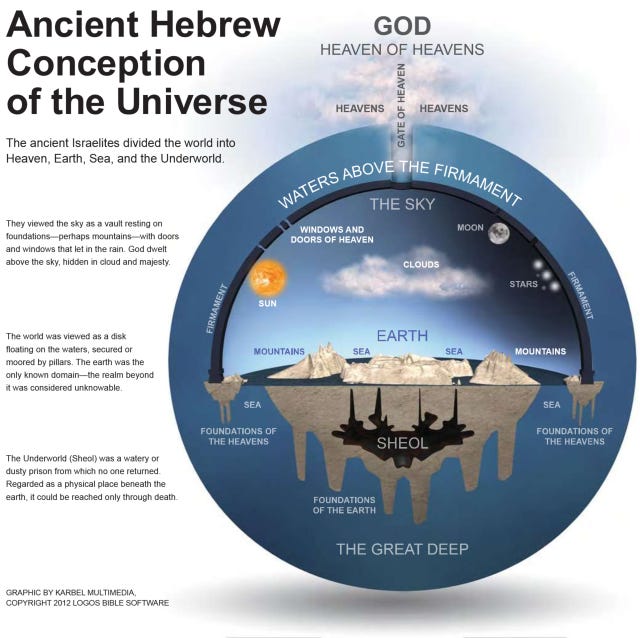
20-21 is essentially a rehash of 17-19, and then 22 is a detailed description of Sheol with separate areas for the righteous, for the sinners, and for those awaiting judgement. Below is a diagram of this Enochian cosmological view, created by Dr. Michael Heiser, and consistent with the Hebrew understanding of the world at this point in time (2500+ years ago).
Day 8 — Thursday, 1/8 — Enoch 24-27, Proverbs 1:20-33
Enoch sees the throne of God on a central high mountain, surrounded by six other glorious mountains with beautiful precious stones and fragrant trees — including the Tree of Life, whose fragrance is enchanting and will seep into our bones after that day of judgement when we all live in glory with God in heaven (!).
Contrasting the heavenly and Sheol visions, Enoch describes seeing Jerusalem as a holy city surrounded by a cursed valley (often associated with Gahenna, a place Jesus will later reference as the location of fiery judgment — which may also be the Valley of the Shadow of Death).
Day 9 — Friday, 1/9 — Enoch 28-36, Proverbs 2:1-5
The account of Enoch’s journey to the places of the luminaries (chaps. 33— 36) briefly summarizes material in chapters 72—82. The Book of the Watchers probably took its present form by the mid- or late third century b.c.e.
Enoch travels to the ends of the earth. He sees storehouses of wind, places where natural forces are controlled by angels, and all manner of divine scents including: frankincense and myrrh, cinnamon, storax (vanilla-like) and galbanum (earthy and green), aloe, almond, cardamom and pepper.
Side note: I am currently in the process of collaborating with a candle-maker to produce Enoch/Bible inspired candles. Stay tuned.
Chapters 33-36 are a summary and preview of The Book of Luminaries discussed in greater detail in 1 Enoch 72-82 — which we will read in early February. Basically, Enoch travels to the ends of the earth charting all the stars, the gates from which they emerge, and how they come forth and their positions and times and months; he sees the origin of all wind and the gates they blow through; as well as the origin of rain and dew and the gate it emerges from.
Day 10 — Saturday, 1/10 — Enoch 83-84 and 106-107, Proverbs 2:6-8
The Dream Vision (Chaps. 83—84)
Enoch recounts two dream visions about future events. In the first he foresees the world’s destruction in the Flood (chaps. 83—84). In its literary line and its typology of Flood and final judgment, the narrative in chapter 83 parallels stories about Noah in chapters 65 and 106-107, and the prayer in chapter 84 is probably dependent on the angelic prayer in chapter 9.
The Birth of Noah (Chaps. 106—107)
According to this narrative, Noah’s miraculous birth foreshadowed his role as the preserver of the human race. Placed at the end of the corpus, the story promises salvation for the righteous, who will survive the great judgment that was prefigured in the Flood. As a literary type, the story parallels accounts of special births in the Hebrew Bible (e.g., Isaac, Samson, and Samuel) as well as the stories of the conceptions of Jesus and John the Baptist in Matthew 1 and Luke 1. Its structure also parallels 1 Enoch 65 and 83.
In 83-84, Enoch has a devastating vision/premonition of the Flood and years later he tells his son, Methuselah, about it.
In 106-107, we learn about Noah’s miraculous and alarming birth. Noah is the grandson of Methuselah — and when he is born, he is described as whiter than snow and redder than a rose, his hair is white and curly like wool, and his face is so glorious that when he opens his eyes the house shines like the sun. He is described as standing up from the hands of the midwife and immediately praising the Lord (!). Lamech is terrified of this infant. He is most concerned that Noah may be born of angels. This isn’t an exciting prospect, he is tremendously upset by it. So much so that he asks Methuselah to track down Enoch (who has been taken) to find out what’s going on. Enoch explains that Noah is in fact Lamech’s fully human child, who has been born righteous and blameless, and will become the only remaining person on earth, along with his three sons and their wives, after a year-long devastating flood to wash away the transgressions of the fallen angels and humankind.
Whew! Ok, back to Genesis. We’ll come back to Enoch for a few days in early February to learn more about the luminaries.
Day 11 — Sunday, 1/11 — Genesis 7-11, Proverbs 2:9-15
Noah’s ark and the flood should probably have a whole entry on its own, but it’s crammed in here on the same day as the Tower of Babel so we can wrap up the early world period of time then move on to Abraham next week. A few key points here:
The flood washing away the sins of humanity and allowing us to start over is a beautiful foreshadowing of baptism, amidst the abject horrors of the reasons for it being required.
While many modern theologians and church doctrines trying to bridge a religious and scientific worldview hold that this was likely a localized flood — there is evidence the world over and in nearly every culture’s origin story a massive, worldwide flood
There is potentially evidence of the ark on or near Mount Ararat
Among other geological features the world over, the Grand Canyon shows evidence of a massive flood — so I’m heading up there to do a little research and will report back with a full post on this in the next few weeks.
The new covenant being a rainbow is curious to think about in light of its modern symbolic use, though I don’t know if I’m ready to dive into that on Substack
Genesis 9 is an absolutely insane chapter that doesn’t get enough attention. First of all, in Genesis 9:20-21, Noah gets off the ark, plants a vineyard, and gets drunk. Why does he get drunk? He’s “righteous and blameless.” Has the opening of the floodgates and the deluge changed the atmosphere? Is that how God shortened the lifespan of humans from nearly 1000 years to 120? And is the atmospheric change why Noah doesn’t handle alcohol the way he did prior to the flood?
And then in Genesis 9:22, we have just a truly astonishing story. And Ham, the father of Canaan, saw the nakedness of his father, and told his two brothers outside. Many Christian scholars hold that “saw the nakedness of his father” is an idiom meaning he slept with Noah’s wife. He slept with his own mother. As an act of dominance. So for the second week in a row we have an implication of force and violence against women. And the sentence includes “father of Canaan” which implies that Canaan is the offspring of this illicit and forceful incestuous act, which would be why in 9:24-27, Canaan is cursed.
And finally, we have the Tower of Babel. I could write whole articles on Genesis 10-11, and in fact much of my previous work does reference these chapters, especially Secret Societies Part 4 and A Brief History of Space and Time — discussing things like the similarities between Nimrod’s story and the Epic of Gilgamesh, Erech being Uruk being modern day Iraq, the Bushes nicknaming themselves Gog and Magog when they were in the not-so-secret society Skull & Bones at Yale.
The Stranger Theology Bible in a Year Study is establishing a “Cosmic Mountain” theme. As we can see from the Book of Enoch, God sits atop a mountain that bridges heaven and earth. As Dr. Joel Muddamalle says, “What do you do when there are no mountains?” (because presumably, they’ve been washed away in a massive flood) “You build one." The Tower of Babel wasn’t just an affront to God because it was the people speaking in one tongue and working together. It was an affront to God because it was, yet again, an attempt to usurp Him by creating a mountain for a lesser deity to sit upon.
Genesis 6:4 says “The Nephilim [giants] were on the earth in those days — and also afterward…” One of the theories is that the wives of Noah’s sons, Ham, Shem, and Japheth, carried the corrupted and/or sinful bloodlines prior to the flood that allowed the giants to return (though maybe not as big as they were before).
Further Reading
If you are interested in learning more about what is discussed in Book of Enoch and the “blurry” parts of Scripture, one of the best theologians on this topic is the late Dr. Michael Heiser.
His book The Unseen Realm has brought back to modern day Christians and Biblical scholars the historic supernatural worldview that was held by the original readers and writers of the Bible. This book is complexly documented and geared towards presenting a scholarly defense to pastors and Biblical students. Dr. Heiser has another version of this book called Supernatural that covers the same material but is written more for a lay audience.
As an Old Testament scholar, Dr. Heiser has written nearly a dozen books, had his own podcast called The Naked Bible, and appeared on many other podcasts (including Blurry Creatures episodes 34 and 134). I currently have his books Angels and Demons checked out of the library, and am reading them in between rearing three children and running this year-long Bible study I inexplicably launched last minute.
Same time next week — and please share your thoughts in the comments and the chat! I’m making a new chat each week going forward since there was so much discussion last week.
So I was thinking about how you said (Adrian) about you think some herbs are ok and some aren’t, which I have to agree. Well you know how it talks about God giving us wine for a merry heart, but we aren’t supposed to get drunk? I was thinking how vodka is made with potatoes and potatoes are a root vegetable. And there was the fallen angel who taught us about root. I think and from experience, some alcohol is just bad for most people, specifically hard alcohol. Also how they call liquor spirits. The categories of alcohol include, wine and spirits so like wine is of God but don’t get drunk and drink in moderation, but spirits should really be avoided by most. I don’t know why I thought about this but I’m interested to see what you all think about this.
My husband and I are loving this and it’s opening up all kinds of discussion that is building our understanding but also, I feel closer to God than ever 🥹 Thank you so much 🙌 I also had this revelation that the Holy Spirit impregnating Mary and Jesus being birthed through a human woman as fully man & fully God, was also a full circle redemption of the great rebellion the angels performed with human women creating their hybrid offspring. Not that they are redeemed…no no no, it is clear they are damned for all eternity (and I feel your planets theory makes so much sense) but the act of defilement they did has been corrected on the earth by the conception and birth of Jesus… 😭🙏🙌 excited to read more and continue on. Thank you 🙏