


This Week
We are reading:
Job 40-42
Enoch 72-82
Exodus 1-9
Psalm 50, 53, 71, 73-76
If you don’t have a hard copy of the Book of Enoch, you can find it online here.
Summary
We’re making our way through three books this week — wrapping up Job, taking another trip to the stars with Enoch, and then beginning the journey of Moses’ Exodus out of Egypt.
Job repents, admits his insignificance and how little he knows in the face of God, and is ultimately rewarded with the doubling of his riches and a long life — seeing the fruition of four generations of his progeny.
But in the end, Job is rewarded not just with the reinstatement of his material possessions and family — Job’s greatest reward is his relationship with God.
And on the heels of Job and the references to the heavenly court, we’re taking a few days to read Enoch’s detailed journey to the stars in 1 Enoch 72-82 — a section commonly referred to as The Book of the Luminaries or The Astronomical Book. The first Book of Enoch is actually 5 separate books or sections that were all written at different times, and this astronomical section was likely written second, after The Book of the Watchers.
What we learn in this section is paramount to understanding space, astrology, and our place within “the universe.” We learn that the stars are for timekeeping, and when humans sin the calendar gets corrupted — begging the question, is the very function of the universe in disarray since the fall of mankind? Did we bring the sun and the moon and the stars down with us?
And then we’re moving right along to start Exodus.
We meet Moses, Moses meets God. God tells Moses he has heard the cries of the Israelites and will deliver them with Moses’ help. Moses, like many Biblical protagonists, struggles with his calling — but God ensures his promises will be fulfilled.
When Moses approaches Pharaoh to “let my people go,” Pharaoh refuses — which does NOT go well for him. The plagues begin, and an interesting article out of Rice university details that each plague is a direct response to a specific Egyptian god.
The Book of Exodus begins to reveal once again that salvation comes from God’s faithfulness to us and not the other way around.
Here is the daily breakdown from our annual plan:
Day 33 — Monday, 2/2 — Job 40-42, Psalm 50
Day 34 — Tuesday, 2/3 — Enoch 72-74, Psalm 53
Day 35 — Wednesday, 2/4 — Enoch 75-78, Psalm 71
Day 36 — Thursday, 2/5 — Enoch 79-82, Psalm 73
Day 37 — Friday, 2/6 — Exodus 1-3, Psalm 74
Day 38 — Saturday, 2/7 — Exodus 4-6, Psalm 75
Day 39 — Sunday, 2/8 — Exodus 7-9, Psalm 76
Day 33 — Monday, 2/2 — Job 40-42, Psalm 50
We wrap up Job with an entire chapter of God detailing the leviathan, an insane sounding sea creature that he is describing with such detail that you know this just has to be real. Sounding at once like a dragon, a dinosaur, and the loch ness monster, I cannot help but wonder what this creature actually was and where it went (or if it’s even actually disappeared).
Job responds with humility, because of course he does. He’s now face-to-face with God, who is describing an INSANE creature — not as a metaphor but as indication of His immense power to create such a chaotic and powerful being, as well as the entire universe.
Most importantly — God doesn’t tell Job why he has suffered. He does not give us a why, He just impresses us with His presence and knowledge — showing us that He is greater than our tiny human brains can ever understand.
Day 34 — Tuesday, 2/3 — Enoch 72-74, Psalm 53
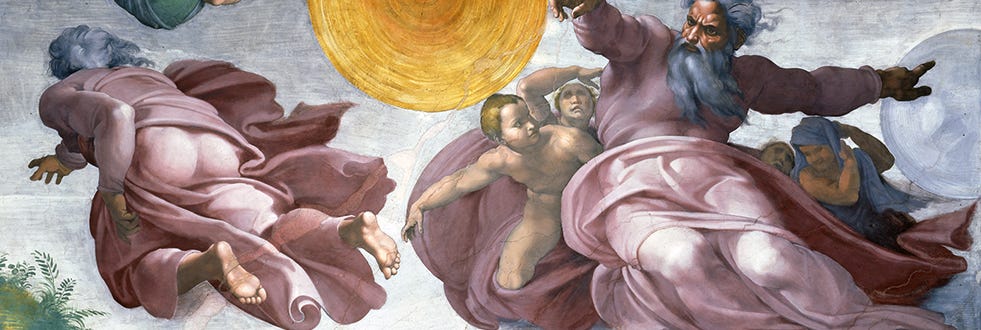
Uriel takes Enoch on a tour of the stars, and today we learn about the Sun and the Moon.
Enoch describes the sun as seven times brighter than the moon — a fact repeated in Isaiah, but one that differs from our modern scientific measurements of the sun’s brightness.
Enoch also notes the sun and the moon are the exact same size — which is true from our perspective on earth, and is how eclipses work. This is one of the facts that dragged me off the agnostic fence because what are the chances that the sun and the moon are EXACTLY the same size from the perspective of earth, without being intentionally designed that way by a Creator?
We also learn the basis for the 364 day solar calendar, and it’s important to understand that when this was likely written it was set upon the backdrop of Jerusalem using a lunar calendar.
35 — Wednesday, 2/4 — Enoch 75-78, Psalm 71
We learn about the gates in the sky, from which all the winds on earth emerge in different directions — as well as rain, dew, mist, hail, snow, prosperity, life, locusts, and destruction. Are there any meteorologists in the Good Book Club? Because honestly, I’m gonna need your take on this section.
Today we learn the names of the sun and the moon and their operations — which is direct push back on paganism and astrology because it details that the sun and moon were named by God, and have roles given by God before humans even existed. Unlike in paganism and astrology, the sun and the moon do not act independently.
Day 36 — Thursday, 2/5 — Enoch 79-82, Psalm 73
Enoch quickly shifts from taking us on a tour of the stars to telling us that the fall of man has confused the calendar, that in the days of sinners the sun and the moon will not appear at their appointed times, and that following the wrong calendar causes us to sin even more. Is this why we have a 365.25 day year, rather than the 364 day year God designed?
1 Enoch 80:7 is a clear and firm rebuke of astrology as divination. Reading destiny in the stars is not cosmic wisdom. It’s theological error, mistaking a demarcation of order for a source of authority on human behavior. God’s intelligently designed cosmological order is not an oracle dictating our fate — it’s a clock.
The entire law of the stars will be closed to the sinners, and the thoughts of those on the earth will err regarding them. They will turn back from all their ways, will err, and will take them to be gods. Evil will multiply against them and punishment will come up on them to destroy all.
1 Enoch 80:7-8
This section ends with the angels telling Enoch to write down the knowledge he has been given to pass down to his son Methuselah, Noah’s grandfather — and the oldest person to ever have lived — so that he can pass this knowledge down for generations to come.
Day 37 — Friday, 2/6 — Exodus 1-3, Psalm 74
We’re now back in the days after Abraham, and Israel has indeed multiplied. So much so that their numbers threaten Pharoah, and Joseph’s deeds are long forgotten.
Pharoah orders the death of the first born male of all Hebrews, but midwives become secret saviors who surreptitiously refuse to follow orders.
We are introduced to Moses — author and main character of much of the Torah, the first 5 books of the Bible. We are working on a future article compiling the historical evidence for Moses — stay tuned!
God reveals Himself in the infamous burning bush. He has heard the cry of His people, and has tapped Moses to lead them to the promised land — the land of milk and honey (new candle scent idea just dropped).
Moses, as with nearly everyone with a divine mission, questions his worthiness to lead the people of Israel. And God’s just like — don’t worry about it, I’ll make it happen and you’ll plunder Egypt.
Day 38 — Saturday, 2/7 — Exodus 4-6, Psalm 75
Moses continues to doubt God’s plan, concerned he won’t be believed. God performs a series of miraculous signs and insists he will make the people listen, using Moses’ brother, Aaron, as a mouthpiece.
Moses and Aaron speak with Pharaoh, telling him to let God’s people go — Pharaoh refuses, doubles the Israelites workload.
Day 39 — Sunday, 2/8 — Exodus 7-9, Psalm 76
God hardens Pharaoh’s heart, granting Himself an opportunity to display His power.
God turns Aaron’s staff to a serpent; Pharaoh calls his own sorcerers to turn their staffs to snakes — but Aaron’s snake eats theirs. Pharaoh remains unconvinced, so…
The plagues begin: the Nile turns to blood, frogs overrun Egypt, lice infest people and animals, swarms of flies cover the land, Egyptian livestock die while Israelites’ livestock are spared, boils afflict Egyptians. Each time Pharaoh relents and begs for mercy, then changes his mind when the plague has ended.
Will Pharaoh’s heart be softened? Will his repentance turn into true submission to God? Tune in next week to find out! (But don’t hold your breath.)
Extra credit: Watch The Prince of Egypt — an animated children’s film about Moses
Whoops — this week’s article got long again! What can I say, I’ve got a lot of thoughts about the Bible.
Share your thoughts in the comments below and in the chat!
I can't believe I used to think The Bible was boring as a child (cradle Catholic). Reading it as a 40yr old is so incredibly emotional and I crave my morning and bedtime readings. Your breakdowns are so helpful and enjoyable.
Job started rough for me lol I was lost. It definitely all came together towards the end. I can appreciate the perseverance (on Job and me 😆) Excited for a bit more of Enoch and Exodus. I’ve said it before, but my soul has been craving this, it’s totally being fed.