

The Good Book Club: Week 8
Exodus 31-40, Leviticus 1-9: The Golden Calf, the Tabernacle, and the Rules - plus, a primer on Lent

This Week
We are reading:
Exodus 31-40
Leviticus 1-9
Psalms 115, 80, 81, 2, 83, 84, 85
Summary
This week we continue Exodus and we get a lot of interaction between God and Moses on the top of Mount Sinai. The mountains are often used as a meeting place between Heaven and Earth.
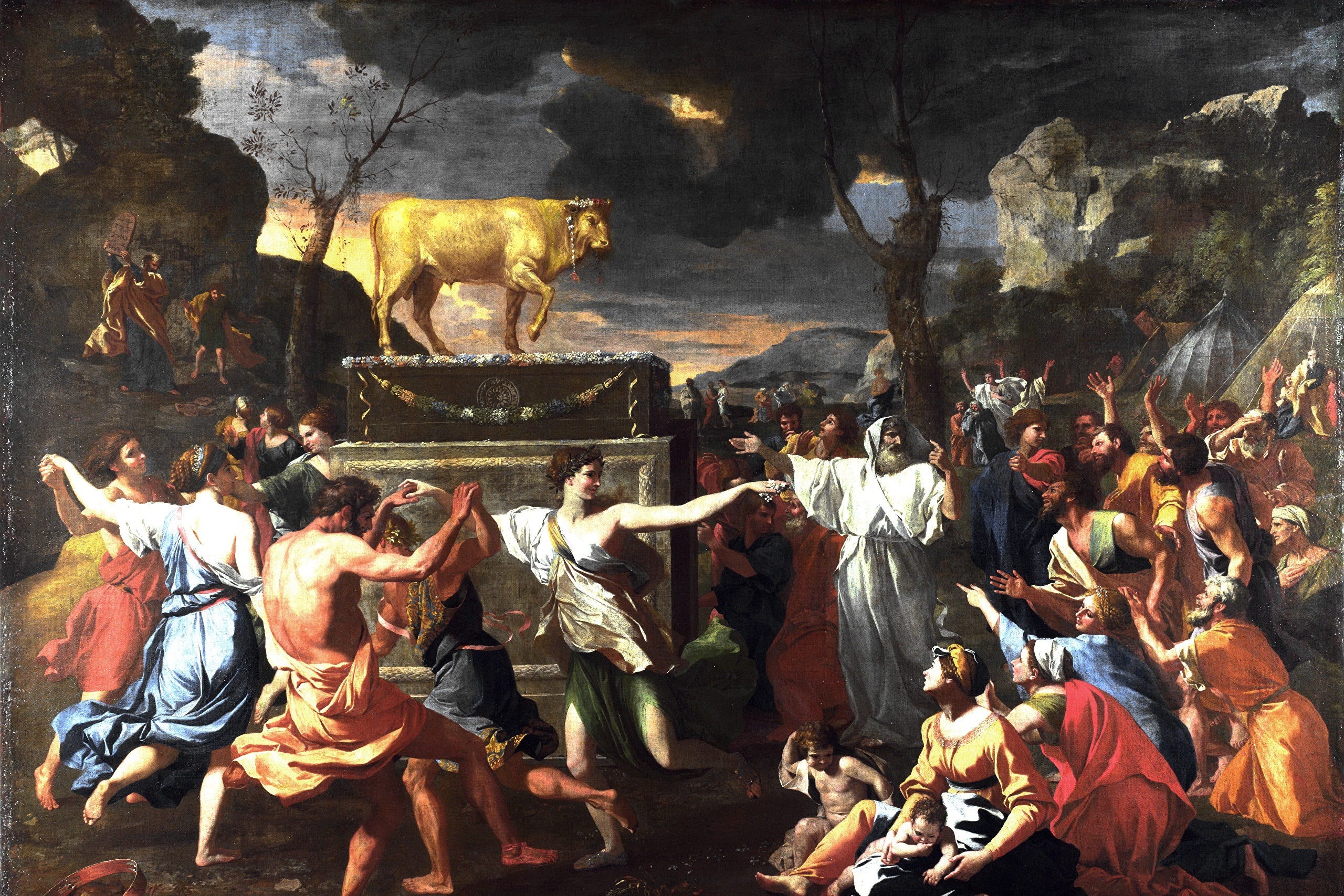
The Israelites are impatient, tempestuous, and weak. Honestly, I used to have a harder time understanding God in the Old Testament, but reading it now I get it. They’re so annoying! These people were just rescued from centuries of slavery to the Egyptians and they can’t go 5 minutes without complaining, and then they build a golden cow?!
Maybe becoming a parent has helped me understand how the depths of both love and wrath can coexist in the same moment.
Fortunately, Moses redeems the Israelites and intercedes on their behalf with God — foreshadowing Jesus. They build the Tabernacle, precisely according to God’s instructions, showing they can follow directions… when they feel like it.
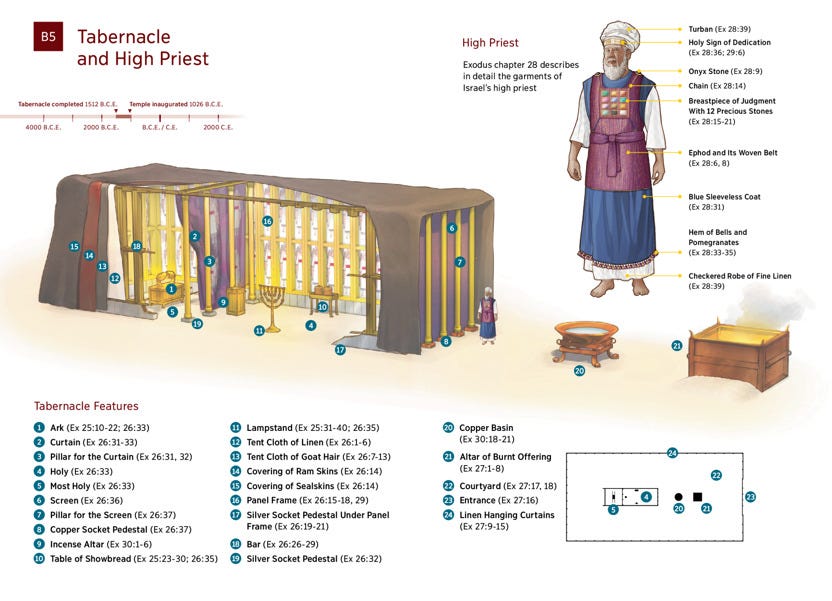
The Tabernacle stands in place of the mountain as a meeting place of heaven and earth. It is akin to a mini-Eden, a place where God dwells among humans. Other parallels between Eden and the Tabernacle include the east-facing entrance guarded by cherubim, the gold, the tree of life (lampstand), and the tree of knowledge (the law). In the Old Testament, God dwells in the Tabernacle, but in the New Testament, Jesus becomes the true Tabernacle.
This Bible study is free for everyone, made possible by the support of our paid subscribers.
If you’d like to support us, please consider a paid subscription. Paid subscribers receive:
Full-length weekly Biblical and archaeological deep dives
New! The Edit weekly newsletter, and access to all community chats
The entire archive of content on health and wellness, secret societies, and more (50+ articles)
After we wrap up Exodus this week, we are beginning Leviticus. For now that we again have a dwelling place for the Lord here on Earth, we need to understand the rules around His holy dwelling.
While Leviticus has a reputation for being boring, this book is important for laying out in detail the ordinary management of sin. God, in all His holiness, is working out a way to dwell with a humanity that has become downtrodden by sin.
One thing to note at the outset of Leviticus is that “unclean” (Hebrew: tamei) doesn’t necessarily mean sinful—it means ritually impure. We’ll see that contact with carcasses, certain animals, or bodily fluids required washing and waiting until evening to become clean — a consequence of unholiness permeating earth and being in physical conflict with holiness, Heaven, and God Himself.
Lent
I’ve been asked to incorporate some more primers on Christianity in general as we continue reading through the Bible. Last week I provided a general overview of the Sacraments, and this week I’m covering Lent — which starts Wednesday, February 18.
Lent is the season of fasting, prayer, and repentance observed by many Christians during the 40 days leading up to Easter. It is a commemoration of Jesus’ 40 days of fasting in the wilderness before beginning His public ministry, which we will discuss when we get to the New Testament.
The practice developed in the early Church as a period of preparation for catechumens (those studying to be Christian) before baptism at Easter, and later became a broader penitential season for all believers. Today it is formally observed in traditions such as the Catholic Church, Eastern Orthodox Church, and many Protestant communities.
The number forty carries deep biblical symbolism of testing, purification, and transformation:
40 days and nights of rain during the flood (Book of Genesis 7:12)
Moses fasting 40 days on Mount Sinai (Book of Exodus 34:28)
Elijah’s 40-day journey to Horeb (First Book of Kings 19:8)
Israel’s 40 years in the wilderness (Book of Numbers 14:33–34)
Lent symbolically places believers in the wilderness with Jesus, stripping away distractions so that the resurrection joy of Easter may be received with renewed depth.
How to Practice Lent
Here are some practical ways you can engage in Lent to meaningfully deepen your faith. Consider practicing a few of the following:
Attend a service or mass on Ash Wednesday (February 18th) and receive ashes on your forehead
Pray more
Set a daily prayer time
Continue reading the Bible in a year!
Fast
Skip meat on Fridays (fish is ok)
Engage in healthy fasting
Give up something that creates comfort (social media, sweets/chocolate, alcohol, entertainment, etc.)
Practice almsgiving
Give to or serve those in need
Repent
Examine your conscience intentionally
Confess specific sins (to a priest or God directly)
Daily Summaries
Here is the daily breakdown from our annual plan:
Day 47 — Monday, 2/16 — Exodus 31-33, Psalm 115
Day 48 — Tuesday, 2/17 — Exodus 34-36, Psalm 80
Day 49 — Wednesday, 2/18 — Exodus 37-38, Psalm 81
Day 50 — Thursday, 2/19 — Exodus 39-40, Psalm 2
Day 51 — Friday, 2/20 — Leviticus 1-3, Psalm 83
Day 52 — Saturday, 2/21 — Leviticus 4-6, Psalm 84
Day 53 — Sunday, 2/22 — Leviticus 7-9, Psalm 85
Day 47 — Monday, 2/16 — Exodus 31-33, Psalm 115
Bezalel (from the tribe of Judah) and Oholiab (from the tribe of Dan) are filled with the Spirit of God for artistic craftsmanship — which is the first explicit mention of someone being Spirit-filled for creativity, not prophecy or warfare. We were made in His image to be creative ✨
Moses meets with God on the top of Mount Sinai and is gone for 40 days. The Israelites freak out and demand Aaron create a new god to lead them out of the wilderness, and he makes a golden calf.
God is SO PISSED, and rightfully so. Moses intercedes, foreshadowing Jesus. The covenant tablets are literally and symbolically shattered.
We have a weird scene in which Moses asks to see God and is only shown His “hind parts” because no one can see His face and live. It’s pretty clear through this and other scenes that there is a scientific reason that we cannot survive seeing God’s face or being directly in His presence — as though our very DNA has been sinfully corrupted from the beginning.
Day 48 — Tuesday, 2/17 — Exodus 34-36, Psalm 80
New tablets are made as God renews the covenant with His chosen people who can’t follow simple instructions
As the Israelites set out to wander across the desert to the Promised Land, God warns Moses not to make treaties with any of the people groups they will meet along the way. He warns that if they do make treaties, they will end up marrying their sons off to foreign daughters, who worship pagan gods — I wonder if this will come up again later?!
Moses comes back down Mount Sinai with the stone tablets carved with the Ten Commandments and his face is shining from having spend 40 days and nights with God.
Bezalel and Oholiab lead the construction of the Tabernacle. While this chapter seems repetitive to the earlier Tabernacle building instructions, it shows that the Israelites can follow instructions — when they want to.
Day 49 — Wednesday, 2/18 — Exodus 37-38, Psalm 81
The Israelites build the Ark of the Covenant (which sits above the law), the Table of Showbread (representing communion), the Lampstand, the Altar of Incense, the Altar of Burnt Offering (at the entrance to the Tabernacle, where access to God begins with a sacrifice), the Washbasin, and the Courtyard.
Day 50 — Thursday, 2/19 — Exodus 39-40, Psalm 2
Bezalel makes the ephod and the breastpiece with 12 gemstones (one for each tribe).
God descends down the mountain and His presence fills the completed Tabernacle in the form of a cloud. He continues to dwell with Israel in the Tabernacle along their journey, appearing as a cloud during the day and at night appearing with fire inside.
Day 51 — Friday, 2/20 — Leviticus 1-3, Psalm 83
In our introduction to Leviticus, we learn about the burnt offering, the grain offering, and the peace offering.
Day 52 — Saturday, 2/21 — Leviticus 4-6, Psalm 84
Next we learn about sin offerings (covering unintentional sins) and guilt offerings. For even if our sin is unintentional, it requires atonement. Ignorance does not negate impact.
Blood is used regularly as a cleansing mediator, as it contains life and purifies the contamination of death.
Day 53 — Sunday, 2/22 — Leviticus 7-9, Psalm 85
Moses washes, clothes, anoints, and consecrates Aaron and his sons. He applies blood to their right ear (anointing what they hear), right thumb (anointing what they touch), and right big toe (anointing where they walk).
Aaron then offers sacrifices for himself, then the people, and God consumes the sacrifices as a divine fire of approval.
As we wrap up this week, I want to just meditate for a moment on the thought of a massively powerful God, greater than any of the other gods they’ve ever seen performing their little magic tricks in Egypt. God dwells with them night and day in a Tabernacle they regularly throw up, tear down, and carry with them through the desert — appearing as a cloud by day, a fiery cloud by night, and divine fire approval when they get the sacrifices right.
Wow.
…let’s read on to find out if they continue disobedience in the face of an immensely powerful God!
Thanks for the Lent info! I’m returning to Catholicism after a long absence and realizing that I never fully understood the meaning and purpose behind a lot of these traditions and practices
The fact that God came down in a cloud is WILD to me. Can you even imagine???